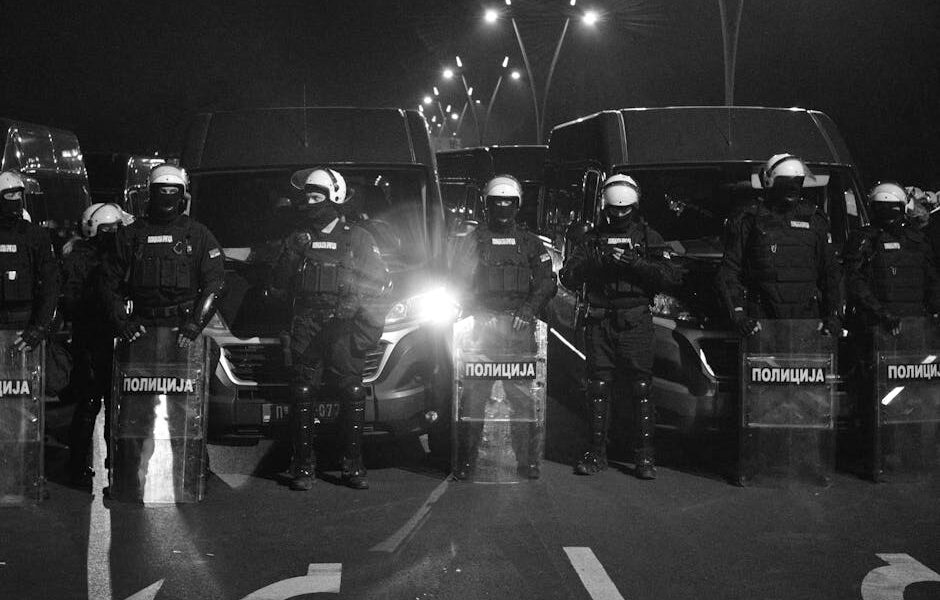
In the heart of Belgrade, what began as a peaceful expression of public anger has descended into a pitched battle between citizens and the state. Riot police and demonstrators clashed late into the night after an anti-government rally that drew thousands into the Serbian capital. The images are stark: masked officers advancing through clouds of tear gas, young protesters hurling objects, and the cobblestones of the old city echoing with the sounds of fury. These Serbia protests are the visible eruption of a deeply buried political and social crisis that has been festering for years.
But behind the smoke and the shouting, this is not just another evening of street violence. It is the visible eruption of a deeply buried political and social crisis that has been festering for years. Serbia, a nation caught between its European aspirations and its authoritarian instincts, is once again confronting a fundamental question: who really holds power — the people or the party?
From Protest to Confrontation: The Escalation of Serbia Protests
The rally itself was organized by a coalition of opposition groups and civil society activists frustrated with what they describe as a slow erosion of democratic norms under President Aleksandar Vučić and his Serbian Progressive Party. Demonstrators had called for electoral reform, media freedom, and an end to corruption. But as night fell, a smaller, more militant group broke away and confronted security forces near government buildings.
Police responded swiftly and forcefully. Water cannons were deployed. Tear gas canisters arced over the crowd. Dozens were detained. The official line, delivered by the interior ministry, blamed the violence on ‘hooligans and extremists’ who had infiltrated an otherwise lawful assembly. But on the ground, the lines between peaceful protester and provocateur were blurred by the chaos.
A Pattern of Tension
This is not an isolated incident. Serbia has seen a wave of protests over the past year, many sparked by specific grievances — a controversial mining law, a crackdown on independent media, the handling of the COVID-19 pandemic. Each time, the government has framed the demonstrations as foreign-inspired or orchestrated by political losers. Each time, the opposition has accused the regime of authoritarian overreach.
The pattern is familiar to anyone who has watched the slow unravelling of democratic checks in the Balkans. Vučić, who has been in power in various capacities since 2014, has consolidated control over the judiciary, the public broadcaster, and key sectors of the economy. His critics argue that Serbia has become a ‘hybrid regime’ — a country with elections, but without genuine competition. The European Union, which officially backs Serbia’s membership bid, has repeatedly raised concerns about the rule of law and media pluralism, but progress has been glacial.
What the Clashes Tell Us
But to frame this simply as a battle between ‘democracy’ and ‘autocracy’ misses a crucial, more uncomfortable truth. The Serbia protests and the subsequent police violence reveal something about Serbian society that goes beyond politics: a profound disconnect between the ruling elite and the everyday realities of ordinary citizens. Wages are low, the cost of living is rising, and young people are leaving the country in droves. The promises of European integration have not translated into tangible improvements for most Serbians.
At the same time, there is a growing impatience with the opposition, which remains fractured and, at times, appears more interested in scoring political points than in building a credible alternative. The protest movement, while passionate, lacks a unified strategy or a clear set of demands beyond ‘Vučić must go.’ That emotional energy is powerful, but without structure, it can easily dissolve into the kind of street confrontations we witnessed — moments that provide dramatic footage but little lasting change.
Beyond the Tear Gas
In the aftermath, both sides will dig in. The government will cite the violence as proof that the opposition is dangerous and irresponsible. The opposition will point to the police response as evidence of a repressive state. The international community will issue carefully worded statements urging restraint and dialogue. Meanwhile, the citizens of Belgrade will sweep up the broken glass and wonder if anything will really change.
The true story of that chaotic evening in Belgrade is not just about a single clash. It is about a country at a crossroads, where the old certainties of the post-Milošević era have dissolved, and the new path forward remains dangerously unclear. Until the deeper social and economic wounds are acknowledged — not just by the government, but by the opposition and the protest movement itself — the streets of Serbia will likely see more nights like this. For more on regional unrest, see A Deadly Blast on a Holiday Train Shatters Pakistan’s Fragile Peace. Learn about the broader context of protest movements from BBC’s analysis of Serbian politics.