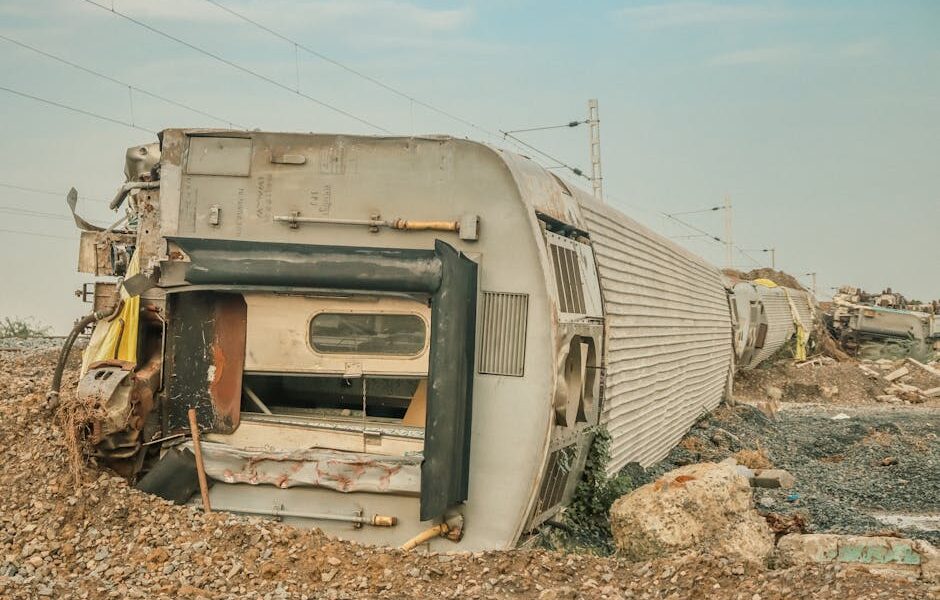
Early Sunday morning, a routine military shuttle train became the scene of a horrific Balochistan train attack in Quetta, the capital of Pakistan’s restive Balochistan province. At least 20 people are dead and more than 70 wounded after an explosion tore through carriages carrying service members and their families home for the Eid holiday. The attack, claimed by the separatist Balochistan Liberation Army (BLA), has reignited fears that the region’s simmering insurgency is far from contained.
The Target: A Train to Eid
The blast occurred as the train passed through Chaman Phatak station. According to railway officials, three coaches and the engine were derailed; two carriages overturned completely. Eyewitnesses described a vehicle packed with explosives slamming into the moving train. The shockwave shattered windows in nearby homes, and residents — woken from sleep — rushed to see mangled, burning metal and scattered belongings. The train was carrying personnel from a military encampment to Quetta’s main station, where they were to board onward journeys to Peshawar and beyond for the holiday. For many, the trip was meant to be a joyful return home.
Beyond the Numbers: A Community Under Siege
While the official death toll stands at 20 — with three soldiers confirmed among the dead — local officials fear the number may rise as rescue teams comb through the wreckage. Hospitals in Quetta have declared an emergency. But the human cost extends far beyond the casualty list. One local resident, Naseer Ahmed, told reporters that his family was asleep when the explosion shattered all his windows. ‘The train was moving and there were passengers on board when the explosion occurred,’ he said, his voice still shaken. For the families of the victims, what should have been a season of celebration has become a nightmare of grief and unanswered questions.
This is not a random act of violence. The BLA has a long history of targeting trains in Balochistan. In March 2025, militants hijacked the Jaffar Express and took passengers hostage. The pattern is deliberate: by hitting trains — arteries of military and civilian movement — the group aims to cripple the state’s control over its own territory. Prime Minister Shehbaz Sharif condemned the attack as ‘cowardly,’ vowing that terrorism cannot weaken the nation’s resolve. But on the ground, many Baloch civilians feel caught between two fires: state repression and insurgent brutality.
The Bitter Context: Why Balochistan Burns
To understand Sunday’s Balochistan train attack, you have to understand Balochistan. It’s Pakistan’s largest province, covering nearly 44% of the country’s land — but home to just 5% of its people. It shares volatile borders with Iran and Afghanistan, and its coastline hugs the Arabian Sea. Beneath its rugged mountains lie vast reserves of natural gas, copper, and gold. The BLA and other groups accuse the federal government of exploiting these riches while leaving the Baloch population in poverty. This economic grievance has fueled a low-intensity insurgency for decades, punctuated by ever more brazen attacks. In early February 2025, violence between BLA fighters and security forces killed 31 civilians across the province.
What the BLA’s bomb on the tracks reveals is that the conflict is not winding down. The group’s statement claiming responsibility described the attack as a suicide operation, suggesting a level of sophistication and commitment that keeps security forces on edge. And while the international community often focuses on Pakistan’s militant groups like the Taliban or ISIS, the BLA represents a distinct challenge — one rooted not in religious extremism, but in nationalism and anger over displacement and resource theft.
An Original Perspective: The Forgotten Fragility of Public Transit
It’s easy to think of a train bombing as a military problem — a security failure to be fixed with more checkpoints or better intelligence. But what gets lost in the headlines is how these attacks shatter ordinary life. In a country where reliable public transport is a lifeline for the poor and middle class, a targeted strike on a train is a strike on the very idea of safe passage. For the families on board that shuttle, their only crime was wanting to celebrate Eid with loved ones. The psychological damage — the fear of boarding a bus, train, or even walking near a station — lingers long after the debris is cleared. The Blast on the tracks doesn’t just kill people; it kills trust. And in a region as fragile as Balochistan, trust is already in dangerously short supply.
As the death toll mounts and investigations begin, one question remains: How many more holidays will be stained with blood before those in power address the root causes — not just the explosions — that keep Balochistan in a state of seige?
For more on regional conflicts, see A Train on a Routine Run Becomes a Target: The Human Cost of Pakistan’s Enduring Conflict. Also, learn about Behind the Headlines: The Quiet Diplomatic Pulse Between India and Pakistan. For external context, read about the Balochistan insurgency on BBC News and the Balochistan conflict on Council on Foreign Relations.