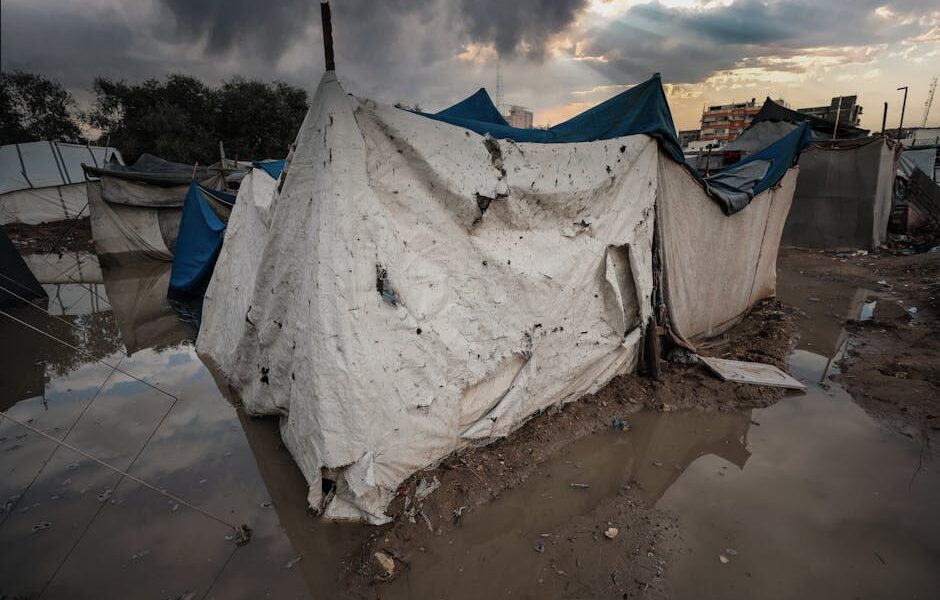
When news of a ceasefire agreement broke earlier this month, many across the world allowed themselves a cautious sigh of relief. For the people of Gaza, those hopes were always fragile — and this week, they have been shattered. Israeli forces struck the Nuseirat and Bureij refugee camps in central Gaza on Saturday, injuring dozens and leaving residents once again scrambling for safety. The attack, captured in footage that has circulated widely, raises a deeply uncomfortable question: What is a ceasefire worth if it isn’t being enforced?
Violence Despite the Deal
The strikes hit densely populated areas in the heart of Gaza — the very zones where tens of thousands of displaced families have sought shelter. According to local medical sources, the injured include children and the elderly. The ceasefire, brokered after weeks of intense diplomacy, was supposed to pause hostilities and allow humanitarian aid to flow. Instead, it now appears to exist only on paper.
This is not an isolated incident. Since the agreement took effect, there have been repeated allegations of violations from both sides. But the scale of Saturday’s assault — involving multiple airstrikes on residential blocks — marks a significant escalation. It has prompted emergency meetings at the United Nations and sharp condemnation from human rights organizations, who say the terms of the truce have been rendered meaningless.
A Pattern of Broken Promises
The ceasefire deal, as originally structured, contained several mechanisms for de-escalation: a mutual halt to attacks, safe corridors for aid convoys, and a commitment to refrain from targeting civilian infrastructure. Yet the events in Nuseirat and Bureij suggest that these safeguards have either been ignored or are too weak to prevent calculated strikes.
Military analysts point out that the geography of the attacks is telling. Both camps are located in central Gaza, far from the northern border where most direct exchanges between Israeli forces and Hamas fighters have occurred. This has led to speculation that the strikes were not a reaction to immediate threats but a deliberate tactic aimed at applying political pressure — a way to signal displeasure with the ceasefire terms without formally breaking them.
The Human Cost of a Flawed Truce
Behind the strategic calculus, however, are real families whose lives have been upended again. I spoke with a teacher from Bureij who described the moment the bombs fell: ‘We heard the planes, then the explosions. My neighbour’s house collapsed. We thought the fighting was over. Now we realize nothing has changed.’ Her words echo a sentiment that is spreading across Gaza — that this ceasefire, like so many before it, has failed the people it was meant to protect.
Medical staff at Al-Aqsa Hospital in Deir al-Balah report that many of the wounded are suffering from shrapnel wounds and crush injuries. The hospital, already operating on limited supplies, is struggling to cope. The attack has also disrupted the delivery of food and water to thousands of families who had begun to return to their homes, hoping for a semblance of normalcy.
What Went Wrong?
One of the core problems with the current ceasefire is that it lacks a robust monitoring mechanism. Unlike some previous agreements that established hotlines between military commands or deployed neutral observers, this deal appears to rely almost entirely on goodwill — a commodity in short supply in a conflict that has spanned decades. Without consequences for violations, there is little incentive for any party to adhere to the terms.
- No independent verification: Neither international monitors nor joint patrols were included in the agreement.
- Ambiguous language: Key phrases like ‘proportional response’ were left open to interpretation.
- Lack of enforcement: There is no penalty clause for attacks that occur during the truce period.
These structural weaknesses created a vacuum that, as events have shown, was quickly filled by force.
An Original Insight: Ceasefires as Political Theater
There is a deeper, uncomfortable truth here that deserves more attention. Ceasefires in protracted conflicts often function less as genuine peace efforts and more as diplomatic theater — a tool for managing international pressure rather than saving lives. The spectacle of a signed agreement allows global powers to claim progress, while on the ground, the violence takes new and sometimes more insidious forms. In this case, the attack on central Gaza may be part of a broader strategy: using limited, targeted strikes to erode the other side’s negotiating position without triggering a full-scale collapse of the deal. This turns the ceasefire into a weapon itself — a way to wage war under the guise of restraint. For civilians caught in the middle, the distinction is meaningless.
What Happens Next?
The attack has already prompted calls for an emergency session of the UN Security Council, and several European governments have expressed alarm. But without a fundamental reworking of the ceasefire agreement — adding real enforcement teeth and accountability — it is difficult to see how this cycle of violence can be broken. Humanitarian agencies are now warning that any further escalation could trigger a mass displacement crisis, as families flee the camps once more.
For now, the people of Nuseirat and Bureij are left to pick up the pieces. The ceasefire continues to exist in name. In reality, it was never much more than a fragile hope — and hope, as it turns out, is not enough to stop a bomb.