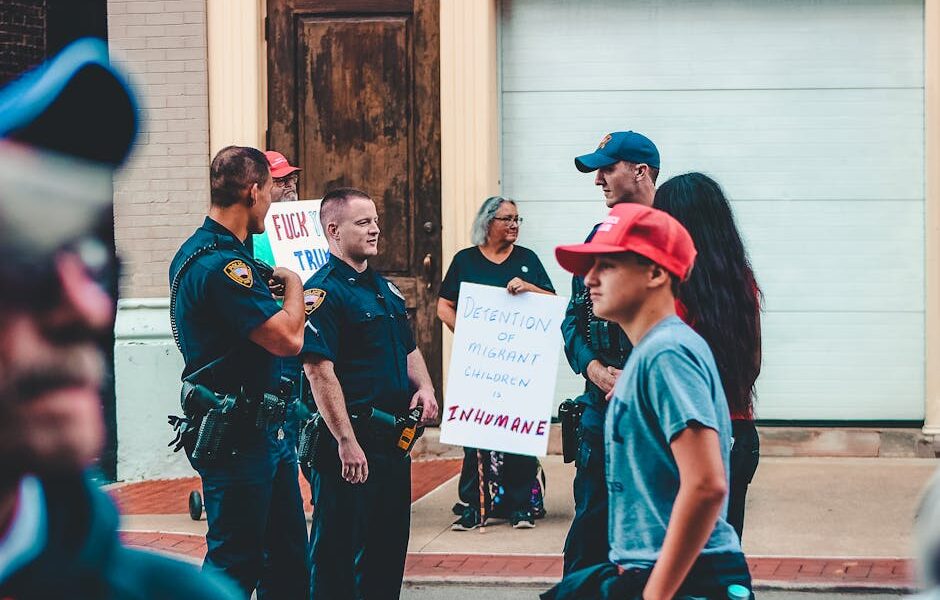
They stand shoulder to shoulder under the New Jersey sky, some in gas masks, others with nothing but their voices. For weeks, the pavement outside Delaney Hall has become a stage for raw, unscripted American drama — a protest movement that refuses to be ignored. But what started as a local outcry has now escalated into a national reckoning over President Trump’s mass deportation agenda, and it’s not just the activists who are angry. At the heart of this turmoil is the Delaney Hall hunger strike, a protest by detainees that has galvanized a community and exposed the deep fissures in America’s immigration system.
Inside the detention center, reports say detainees have launched a hunger strike. Outside, a coalition of residents, clergy, and members of Congress are demanding answers. The result is a standoff that cuts to the heart of who we are as a country.
The Delaney Hall Hunger Strike That Changed Everything
The current wave of protests was triggered by news that immigrants held at Delaney Hall were refusing food to protest conditions they describe as inhumane. While the specifics remain murky — ICE has not confirmed the strike – Democratic lawmakers who toured the facility this week paint a grim picture. Congressman Frank Pallone said he saw “moldy food” and detainees who had been waiting over a week for medical attention.
Governor Mikie Sherrill, a Democrat elected last year, has tried repeatedly to inspect the facility. Each time, she says, her team was turned away or given only partial access. “Refusing to provide full access raises serious questions about what ICE is trying to hide from public view,” she said in a statement. Her words have become a rallying cry.
A Facility Reopened, A Community Outraged
Delaney Hall, located just outside Newark, sat empty for years before being quietly reopened in February 2025. Mayor Ras Baraka insists the reopening happened without proper permits or approvals from the city. That bureaucratic tussle might have stayed local — except that Delaney Hall is now part of a much larger machinery: the Trump administration’s push to deport record numbers of undocumented immigrants.
The facility is run by GEO Group, a private prison contractor that has faced criticism in other states for cost-cutting and lack of transparency. For activists, Delaney Hall is a symbol of a system that values profit over people. For the administration, it’s a necessary tool in enforcing immigration law.
Clashes on the Pavement, Questions in the Air
On Wednesday night, the tension boiled over. Protesters formed a human chain to block vehicles from entering the center. Law enforcement moved in. The Department of Homeland Security says six people were arrested for assaulting federal agents. But witnesses describe a chaotic scene where pepper spray and batons were used on demonstrators, some of whom had simply linked arms in peaceful defiance.
One protester we spoke with, who asked not to be named for fear of retaliation, said: “We’re not here to fight. We’re here to bear witness. If they see us as criminals for that, then something is deeply broken.”
Congressional Oversight or Political Theater?
The arrests are part of a pattern that worries First Amendment advocates. A year ago, Mayor Baraka was arrested during a protest for trespassing. Charges were dropped. But then the administration charged Representative LaMonica McIver with assault. She denies the charge and calls it “purely political.”
This week, three Democratic representatives — Jerry Nadler, Daniel Goldman, and Adriano Espaillat – toured Delaney Hall. They described “dire conditions,” including evidence of medical neglect. Yet the administration has accused lawmakers of exaggerating for political gain. The back-and-forth leaves ordinary citizens wondering: whom do we trust?
It’s important to remember that members of Congress have a legal right to inspect federal facilities. When that right is denied, even temporarily, it chips away at the system of checks and balances that is supposed to protect us all. For more on how immigration policies affect communities, read our analysis on South Africa’s migration crisis.
The Hidden Toll Beyond the Headlines
Here’s what often gets lost in the shouting: data from CNN reports that 50 immigrants have died in detention during President Trump’s second term. That’s the highest number in at least two decades. Each death is a story of a person — a parent, a sibling, a neighbor — who entered a facility seeking due process and never came out.
These are not abstract statistics. They represent families left behind, and a system that too often treats human beings as paperwork. While the protesters outside Delaney Hall hold signs calling the center a “concentration camp,” the more measured truth is that we simply don’t know the full extent of what happens behind those walls. And that lack of transparency is itself a crisis.
What Comes Next?
The protesters are vowing to stay until Delaney Hall closes. Governor Sherrill has backed them. But with the Trump administration committed to its deportation campaign, a compromise seems distant.
One thing is clear: the images from Newark this week are not just about one facility. They are a snapshot of a nation struggling to reconcile its ideals with its actions. The Delaney Hall hunger strike inside may be quiet, but the echoes are being heard from city hall to Capitol Hill. For a broader perspective on immigration challenges, see our report on World Cup visa crises.
As for the detainees, their fate is uncertain. As for the protesters, they will be back tomorrow. And as for the rest of us, we might ask ourselves: how much are we willing to let happen in our name?