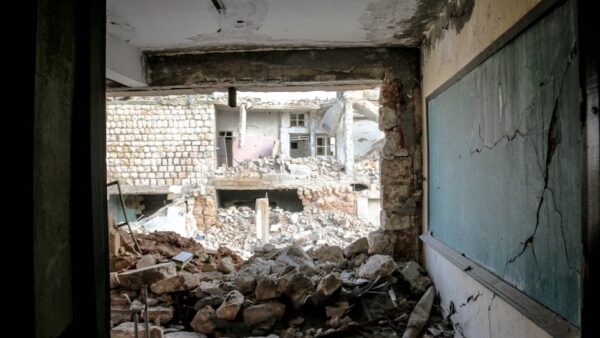
As the war in Ukraine grinds into its third year, a curious shift is taking place in European capitals. The idea of talking to Vladimir Putin, once politically toxic, is quietly creeping back onto the agenda. Ukraine itself is now asking the European Union to step up and mediate — not as a replacement for the stalled US efforts, but as a fresh voice in a negotiation that has gone nowhere. This EU mediation Ukraine effort represents a critical test for European diplomacy.
Ukraine’s foreign minister, Andrii Sybiha, recently told the BBC that Kyiv wants “new dynamics” in the peace process. That’s diplomatic code for: the current approach isn’t working. And he’s right. The Trump administration’s envoys have pressed Kyiv hard while giving Moscow a relatively free pass, yet the result has been more Russian bombs, not fewer. Last week alone, Kyiv endured one of the heaviest drone and missile barrages of the war, and the Kremlin is now threatening “systematic strikes” on the capital.
So the EU is dusting off its diplomatic playbook. The bloc’s foreign policy chief, Kaja Kallas, has circulated discussion papers ahead of an informal foreign ministers’ meeting in Cyprus this week. The goal: figure out whether Europe can even have a unified position on re-engaging with Moscow — and if so, who might lead that charge.
The Search for a ‘Russia Whisperer’ in EU Mediation Ukraine
Rumoured candidates for the role of EU envoy read like a list of political heavyweights: former German chancellor Angela Merkel, ex-Italian prime minister Mario Draghi, and Finnish president Alexander Stubb. Stubb has been the most candid, saying he’d “probably not say no” — but only if Russia agrees to a ceasefire first. That’s a big if.
Moscow, predictably, has its own preference: Gerhard Schröder, the former German chancellor who now sits on the boards of Russian energy companies. Kallas shot that down fast, noting that Schröder would be “sitting on both sides of the table.” It’s a reminder that any European mediator must be seen as credible and impartial — or risk being a tool of Russian influence.
Internal Divisions and a Lack of Leverage
Not everyone in the EU is on board with this push. Countries like Sweden and Lithuania argue that Russia is already under pressure and that the West should squeeze harder, not ease off. Others, like Italy, believe staying on the sidelines is no longer tenable. This is the tension at the heart of the Cyprus talks: is engagement a sign of strength or desperation?
Kyiv-based analyst Yaroslav Smovzh, from the Adastra think tank, offers a sobering view. He thinks any EU mediation Ukraine is “doomed” unless Europe comes from a position of real leverage. “If Europe wants to act as an independent and neutral intermediary, it will not yield any results — just like the US did not achieve any success,” he says. His prescription: “Russia needs to be intimidated.”
That’s easier said than done. Europe’s military aid has been significant but hesitant, and its energy dependence on Russia, while reduced, isn’t zero. Moscow knows this. Putin has made clear he prefers talking to Washington, partly for status reasons, partly because the US has been less confrontational. Now that those talks have fizzled, the Kremlin seems content to escalate militarily rather than negotiate in good faith.
Ukraine’s Own Pressure Campaign
While Europe debates who should sit across from Putin, Ukraine hasn’t been waiting for permission. It has ramped up its own long-range strikes on Russian oil infrastructure — what Kyiv calls “long-range sanctions.” These attacks have rattled Moscow and may partly explain the intensity of recent Russian strikes on Ukrainian cities. It’s a brutal cycle: each side tries to improve its bargaining position by causing more pain.
MP Yehor Chernev, from Ukraine’s ruling party, acknowledges there are “no signals that Russia wants to end this war.” But he sees the EU’s potential role as a way to inject “new energy” into diplomacy. “They will represent the EU, which clearly understands the threat from Russia,” he says.
That may be true, but understanding a threat and countering it are two different things. Europe’s challenge isn’t just finding the right envoy — it’s deciding whether it has the stomach to back up diplomacy with credible deterrence.
An Original Insight: The Risk of Talking for Talking’s Sake
Here’s what’s missing from much of the current discussion: the sheer asymmetry of interests between the EU and Russia. Europe wants a stable, predictable security arrangement. Russia, under Putin, has shown that it values instability as a tool — it erodes Ukraine’s will, fractures Western unity, and keeps energy markets volatile. A mediator assumes both sides want to reach a deal. But if one side sees negotiation as just another battlefield, then any envoy — no matter how skilled — risks being used as a prop for Russian propaganda.
The EU should ask itself a hard question: is it ready to walk away from talks the moment Moscow uses them to buy time for more offensives? Because without that resolve, the search for a “Russia whisperer” could become just another chapter in a long history of European diplomacy that sounded good but accomplished little.
The Cyprus meeting won’t produce a breakthrough. But it will test whether the EU can speak with one voice — or whether, when faced with a predator, it still prefers to talk while the predator keeps hunting.
For more on the broader diplomatic context, see our analysis on Moscow’s veiled ultimatum to diplomats. Additionally, the global tensions stress-testing the system highlight the stakes of EU mediation Ukraine. For external perspectives, the European External Action Service provides official updates, and International Crisis Group offers in-depth analysis on Ukraine peace efforts.