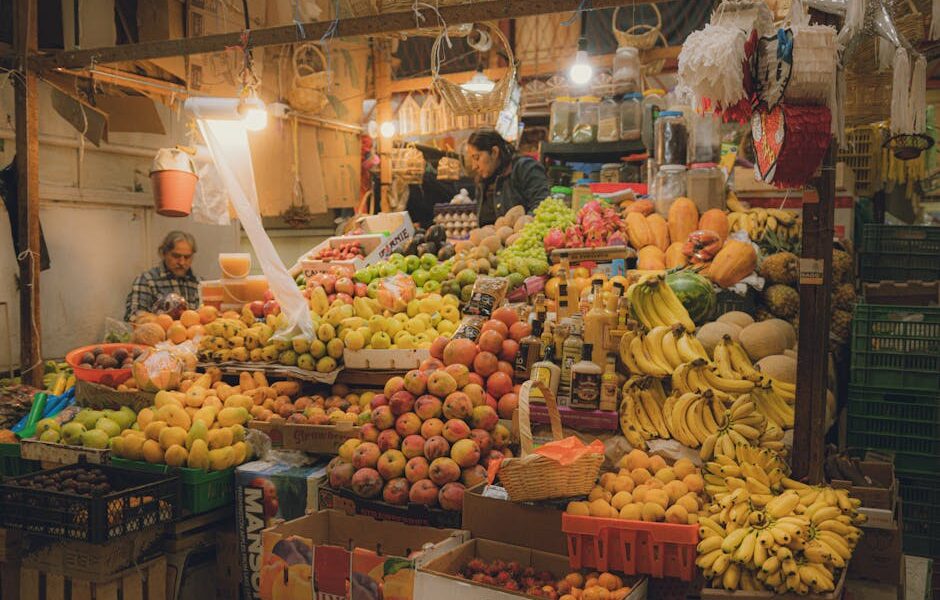
In the bustling aisles of Monterrey’s Mercado de Abastos, a quiet revolution is underway. Shoppers are no longer loading up carts with the usual bundles of tomatoes, chilies, and beef. Instead, they’re carefully counting pesos, comparing prices across stalls, and leaving with smaller bags. This isn’t just a seasonal dip—it’s a symptom of a deeper food system under siege.
For Cesar Ramirez, a 66-year-old retiree, the math is simple and grim. “You have to buy them anyway; they’re things you use daily,” he says of the staples that have jumped in price. But that necessity is colliding with a harsh reality: the basic food basket in urban Mexico rose 8.1 percent in March, far outpacing the overall inflation rate of 4.45 percent. And for the millions of Mexicans working in the informal economy—nearly 55 percent of the labor force—there’s no safety net.
The Hidden Costs on Your Plate
The price spikes are not coming from a single source. Instead, they are the result of a perfect storm of global and local pressures. Fuel costs have surged as geopolitical tensions in the Strait of Hormuz disrupt shipping, directly impacting transportation and refrigeration. Mexico imports more than half its gasoline and 75 percent of its natural gas, so when global energy prices rise, the entire supply chain feels the heat.
Meanwhile, fertilizer prices have skyrocketed. Between January and March, the cost of urea—a key agricultural input—rose 47 percent, while other fertilizers jumped more than 50 percent. Since Mexico imports 70 percent of its fertilizer, farmers are paying far more to grow the same crops. Those costs are passed down the line, from the field to the market stall.
Add to that a 17 percent tariff imposed by the United States on Mexican tomatoes last year. As Ilda Castro, a shop owner at the Mercado de Abastos, explains, “We heard that, in the United States, they’re paying $65 for a 25-pound box. Logically, any producer would prefer to send their tomatoes there.” The result? A kilo of tomatoes that once cost 20 pesos now runs as high as 75 pesos.
Security: The Unseen Tax on Food
Perhaps the most alarming factor is one that doesn’t show up on any official price tag: insecurity. Extortion, highway robberies, and protection rackets are becoming routine costs of doing business. Cuauhtemoc Rivera, president of the Alliance of Small Merchants, notes that extortion touches every link in the chain, from the farmer to the corner-store owner.
In January, authorities arrested Cesar Sepulveda Arellano, alias “El Botox”, for the murder of a prominent lemon-sector leader in Michoacan. The National Agricultural Council called the case a stark reminder that “insecurity not only puts food producers at risk, but also impacts final product prices, distorts markets, and threatens supply.”
For vendors like Graciano Rico, the solution is to absorb the pain. He has cut his profit margins nearly in half to keep customers coming back. “If we raise prices too much, they’ll leave and resent it,” he says. But his shop has already seen a 25–30 percent drop in sales compared to last year.
Who Pays the Price?
The biggest burden falls on the poor. Elvira Pasillas, a professor at ITESO, points out that low-income families already spend nearly 70 percent of their earnings on food. “Not only are they struggling to meet minimum nutritional requirements, but they are also spending almost all of their income on food,” she says. For households where a single construction worker is the sole breadwinner—like that of 62-year-old Guillermina Delgado, who also cares for her mother—there’s no room for error. “There’s not one single thing that’s cheap anymore,” she says.
A System Under Pressure
The government has tried to ease the pain by renewing voluntary price agreements on fuel and cutting the fuel tax. But Pasillas warns that these subsidies come with a cost: reduced tax revenue and less money for social programs that support the poor. At a time when GDP contracted 0.8 percent in the first quarter, the trade-off is becoming more dangerous.
The real story here is not just about rising prices. It’s about a food system that is brittle. When fuel disruptions, trade disputes, security failures, and fertilizer price hikes all hit at once, the consequences ripple out to every dinner table. And for the millions of Mexicans already living on the edge, the margins are disappearing.
As shoppers learn to ration, swap fresh tomatoes for canned, and serve smaller portions of salsa, they are adapting to a new reality. But adaptation is not the same as stability. Without deeper changes—in trade policy, security, and investment in local agriculture—the strain on Mexico’s pantry will only grow.