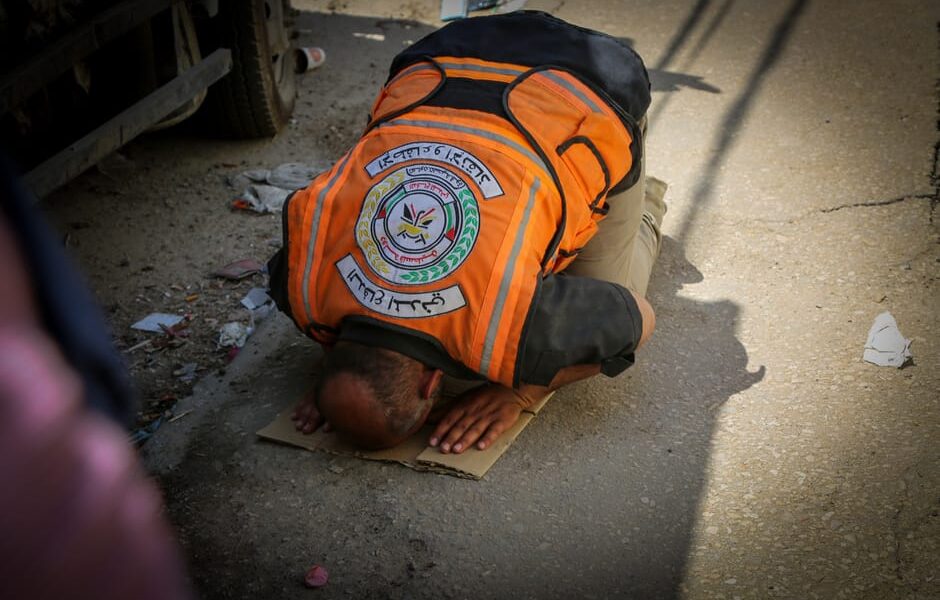
The smell of grilled meat and spices usually fills the air of Gaza City’s main market district ahead of Eid al-Adha. This year, it was replaced by the acrid scent of burning concrete and dust. On Tuesday, an Israeli airstrike collapsed the upper floors of the al-Kayali building, a residential structure in the heart of the commercial zone, as shoppers were preparing for the holiday. At least three people were killed and dozens wounded, according to local medics. This incident is one of the latest Gaza ceasefire violations that continue to undermine the fragile truce.
Israel’s military and Shin Bet security service announced that the target was Mohammed Odeh, the newly appointed commander of Hamas’s military wing. They said the strike came after months of tracking his movements. The strike hit multiple floors and a nearby apartment linked to a Hamas operative involved in the October 7 attack. But for the civilians caught in the blast radius—the fruit sellers, the families buying new clothes for the feast—the geopolitical justification offers little comfort as they sift through rubble.
Targeted Killings and the Fiction of a Truce: Gaza Ceasefire Violations in Focus
This operation marks the second time in under a month that Israel has killed the top commander of Hamas’s armed wing. Odeh’s predecessor, Izz ad-Din al-Haddad, was eliminated in a similar residential strike in May. The pattern is becoming alarmingly routine: an intelligence-driven pinpoint strike that levels a building in a populated area, followed by a statement from Prime Minister Benjamin Netanyahu’s office calling the target an architect of the October 7 massacre.
Netanyahu has promised to “reach them all.” But the question lingering over Gaza—and increasingly, over international diplomatic circles—is whether this approach is a strategy or an admission of failure. The ceasefire that began in October was supposed to halt hostilities and pave the way for a US-led peace plan. Instead, Israeli forces have conducted regular strikes across the strip, killing more than 900 people during the supposed truce, per Gaza’s health ministry. These Gaza ceasefire violations highlight the gap between diplomatic promises and military reality.
Who Really Controls the Streets?
One of the uncomfortable truths that the ceasefire was meant to solve is the question of governance. The later phases of the peace plan envision a transitional, technocratic administration running Gaza, alongside demilitarization and reconstruction. But those talks have stalled, particularly after the conflict with Iran escalated in February. Meanwhile, Hamas has reactivated its police force and appears to be reasserting its authority in the territory. In other words, the vacuum that the strikes are trying to create is being filled by the very organization Israel is targeting.
It is a paradox of counterinsurgency: killing leaders disrupts command, but it also eliminates potential partners for negotiation. Odeh had been on Israel’s radar for months. Why wait to strike him during a ceasefire? Because, as Israel argues, the ceasefire does not apply to “terror operatives.” But Hamas sees it as a blatant violation of the truce terms, adding to the list of Gaza ceasefire violations.
Original Insight: The Ceasefire as a Siege by Other Means
What is often lost in the coverage of these “targeted strikes” is the operational logic behind the timing. By hitting Odeh just days after his predecessor’s death, Israel is signalling a ruthless continuity: no amount of rotation at the top of Hamas will stop the drone feeds. But this creates a perverse incentive for Hamas to decentralize further, pushing decision-making into smaller, harder-to-track cells. The result is a security dilemma where Israel must launch more strikes to catch more commanders, each strike eroding the already thin trust that a political solution is possible.
Moreover, the strikes serve a domestic purpose for Netanyahu. In a time of war, every successful elimination is a victory lap—a visceral demonstration of reach and resolve. But it also crowds out the space for political compromise. When the other side cannot guarantee the safety of its own leadership, who will step forward to negotiate disarmament? The cycle of Gaza ceasefire violations makes such negotiations increasingly unlikely.
Human Cost in a Holiday Season
The timing of this week’s attack is particularly jarring. Eid al-Adha is a time of charity and family gatherings. Instead, rescue teams struggled to reach the upper floors of the al-Kayali building because the streets were clogged with debris and panic. Witnesses reported seeing five missiles hit the building almost simultaneously from different directions, a technique designed to prevent escape but one that also flattens the surrounding infrastructure.
Israel has also ramped up operations in Lebanon, vowing to escalate against Hezbollah after killing 31 people there. The risk of a multi-front war is real, and the ceasefire in Gaza is looking less like a pause and more like an intermission between acts of a longer tragedy. For more on the broader regional impact, read our analysis on ceasefire unraveling in Lebanon.
One resident of Gaza City, speaking to local media, summed up the feeling of many: “We are not safe anywhere, not even in a ceasefire.”
For all the smart bombs and intelligence tracking, the most persistent reality on the ground is this: the ceasefire has not stopped the killing. It has only changed the tempo. Until the political track catches up to the military one, the markets of Gaza will remain places where you go to buy vegetables and risk coming home in a body bag. For further context on the challenges of peace, see this report from BBC News on Gaza ceasefire challenges.