When a vehicle carrying Ugandan tax officials slammed into an elephant on a highway cutting through Murchison Falls National Park, the result was tragic but not entirely surprising. Three people died and four others were injured in the crash on Sunday evening, according to police reports. The incident has once again drawn attention to a simmering crisis across East Africa: as human settlements expand into protected wildlife zones, deadly encounters between people and animals are becoming more frequent. This tragedy underscores the urgent challenge of human-wildlife conflict Uganda faces as development encroaches on natural habitats.
The car, occupied by employees of the Uganda Revenue Authority, was traveling from Arua to the capital Kampala when the collision occurred. Police have confirmed that the injured were first taken to a local hospital before being transferred to Kampala for more specialized care. Officials have not disclosed the condition of the elephant involved.
A Dangerous Road Through a Wild Corridor: A Hotspot for Human-Wildlife Conflict Uganda
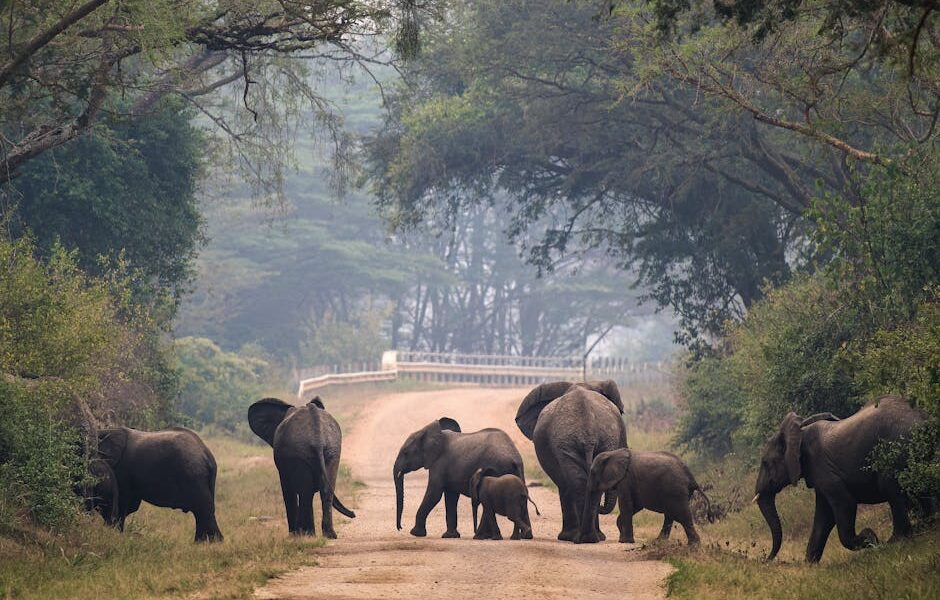
The crash took place on a stretch of road that cuts directly through the national park—a common layout in Uganda where highways sometimes bisect protected areas. For drivers, this means navigating not only potholes and reckless drivers but also the sudden appearance of large animals like elephants, buffalo, and giraffes. Road accidents are already a major cause of death in Uganda, and adding unpredictable wildlife into the mix turns an already risky journey into a gamble.
Following the incident, the Uganda Wildlife Authority issued a statement urging motorists to exercise extreme caution when driving through protected areas. ‘Motorists traveling through Protected Areas are strongly advised to drive cautiously, as wild animals frequently cross the roads,’ the statement read.
Pressure on Protected Areas
Behind the immediate tragedy lies a deeper trend: communities are pushing ever closer to national parks as Uganda’s population grows and land becomes scarcer. Agriculture, new settlements, and infrastructure projects are all encroaching on habitats that were once considered secure. As a result, elephants and other wildlife are forced into closer contact with humans, often with fatal outcomes for both sides. This pattern of human-wildlife conflict Uganda is escalating rapidly.
This is not an isolated problem. Across Africa, from Kenya to Botswana, conservationists are grappling with how to balance development with wildlife protection. In Uganda, the situation is particularly acute along the boundary of Murchison Falls National Park, where farming villages have sprung up virtually at the park’s edge. Animals that wander onto roads or into fields are met with speeding vehicles or angry farmers, and the results are almost never good for anyone.
The URA officials were likely unaware of the heightened risk they faced as they traveled through the park after dark—a time when wildlife is most active. Speed, poor lighting, and a lack of animal crossings or fencing all contributed to the deadly outcome. Addressing human-wildlife conflict Uganda requires urgent action.
What Can Be Done?
Experts point to a few practical solutions: better signage, speed bumps, and wildlife underpasses or overpasses could reduce collisions dramatically. But these measures require funding and political will. In the meantime, drivers are left with little more than a warning to stay alert. That’s cold comfort for the families of those who lost their lives on that lonely stretch of road in northwestern Uganda.
The tragedy also raises a question that conservationists struggle with: how do we protect large, dangerous animals when human lives are at stake? Culling or relocating elephants is unpopular and expensive. Fencing entire parks is often impractical. The most hopeful path forward may be community-based conservation that gives local people a direct stake in protecting wildlife. But until those solutions take hold, the road through Murchison Falls will remain a place where a simple drive home can turn deadly in an instant. For more on similar challenges, see this article on conflict and disease in DR Congo. Learn more about global conservation efforts at World Wildlife Fund. Also, explore how Ebola meets war in eastern Congo for another perspective on human-wildlife conflict.