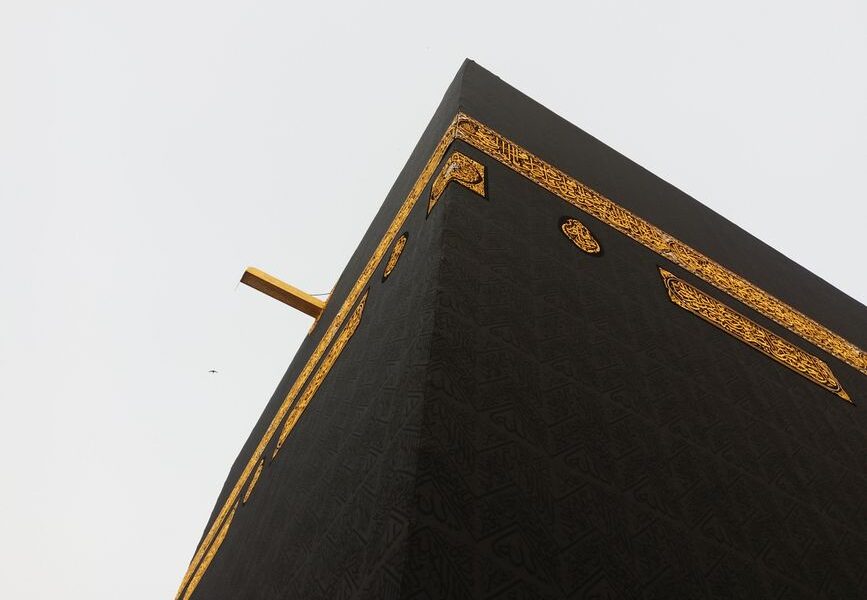
If you have ever watched the hajj on television, you have seen it. That enormous, shimmering black cloth known as the Kiswa Kaaba cloth that covers the Kaaba in Mecca. It catches the light, ripples in the desert wind, and frames millions of pilgrims in white. Most people assume it is just a ceremonial sheet — something hoisted up once a year, maybe embroidered with gold. They are wrong. The Kiswa is one of the most complex, politically charged, and technically mind-bending textiles ever woven by human hands. And for thirteen centuries, it has been at the center of empires, rivalries, and a secretive craft that few outsiders have ever fully witnessed.
The Workshop You Will Never Visit: Crafting the Kiswa Kaaba Cloth
There is a factory in Mecca, tucked away near the holy mosque, that employs about 200 master artisans. They do not give tours. Outsiders need special permission from the Saudi government just to peek inside. Inside, you will not find robots or assembly lines. You will find men bent over giant hand-operated looms, threading pure silk thread so fine that a single mistake can ruin weeks of work. The Kiswa requires 670 kilograms of silk — white silk that is imported, then dyed black in a secret process that has been passed down like a family heirloom for generations. The gold embroidery? That is not thread. It is 120 kilograms of pure gold wire wrapped around a silk core. Each sheet of the Kiswa takes nearly a year to complete. Twelve sheets, fitted together like a giant quilt, cover the cube-shaped building. The entire operation is funded directly by the Saudi royal family, and its cost is never publicly disclosed.
A Cloth That Changed Hands Over and Over
Here is the part that surprises most people: the Kaaba has been dressed in a special cloth long before Islam. The tradition goes back to pre-Islamic times, when various Yemeni tribes would offer covers. After the rise of Islam, the caliphs took over. But what many do not realize is that for hundreds of years, the Kiswa was not made in Arabia at all. It was woven in Egypt. Every year, a grand caravan would carry the new Kiswa from Cairo to Mecca, a journey that took weeks and was treated as a state ceremony. The Ottomans continued this tradition. When the British occupied Egypt in the 1920s, they briefly tried to stop the shipment, causing an uproar across the Muslim world. It was only in 1962, under King Faisal of Saudi Arabia, that the kingdom finally built its own factory and reclaimed the production. That was a power move as much as a religious one. It signaled that Saudi Arabia, not Egypt or Turkey, was the true guardian of Islam’s holiest site.
What Tourists Never See
Every year, on the 9th of Dhul Hijjah, the old Kiswa is removed and replaced with a new one. The old cloth is not burned. It is not stored in a vault. It is cut into small squares and given as gifts to VIPs, foreign dignitaries, and select Islamic institutions. Some pieces have ended up in museums in Istanbul, London, and Kuala Lumpur. Others have been sold on the black market for thousands of dollars. There is even a rumor — unverified, but persistent — that a scrap of Kiswa from the 19th century is kept in a private collection in Vienna. The Saudi government officially forbids the sale of Kiswa pieces, but the illegal trade persists. For many collectors, owning a piece of the cloth is like owning a piece of the sacred itself.
The Elephant in the Room: Politics and the Kaaba
Let us be honest. The Kiswa is not just a religious artifact. It is a political billboard. Saudi Arabia’s control over the Kiswa factory is a quiet but powerful statement of leadership in the Muslim world. When Iran’s government criticizes Saudi custodianship of Mecca, the Saudis point to the factory as proof of their devotion. When rival Gulf states like the UAE try to assert religious influence, the Kiswa remains a Saudi monopoly. And in recent years, there has been debate behind closed doors about whether the design of the Kiswa — currently featuring Quranic verses in a specific calligraphic style — should be modernized. Traditionalists say no. Reformists whisper about adding more color, or changing the black to deep blue, as was done briefly in the 16th century. So far, black has won.
An Unseen Burden on Pilgrims
Most Muslims have no idea that the Kiswa costs millions of dollars to produce each year. Many would be shocked to learn that the gold alone represents a significant expense in a kingdom that still struggles with budget deficits. But for the average pilgrim, the Kiswa is simply a backdrop. They touch it. They kiss it. They weep beneath it. And they assume it has always been there, eternal and unchanging. It is not. It is a fragile, handcrafted miracle, sewn by tired men in a guarded factory, funded by oil money, and freighted with centuries of ambition. The next time you see that black cloth on a news broadcast, do not just see a symbol. See the empire, the craft, and the 1,300-year-old obsession that keeps it hanging there. For more on the intersection of faith and geopolitics, read about global trust deficits or explore Iran’s fragile ceasefire. Learn more about the history of the Kiswa from Britannica and Islamic Landmarks.