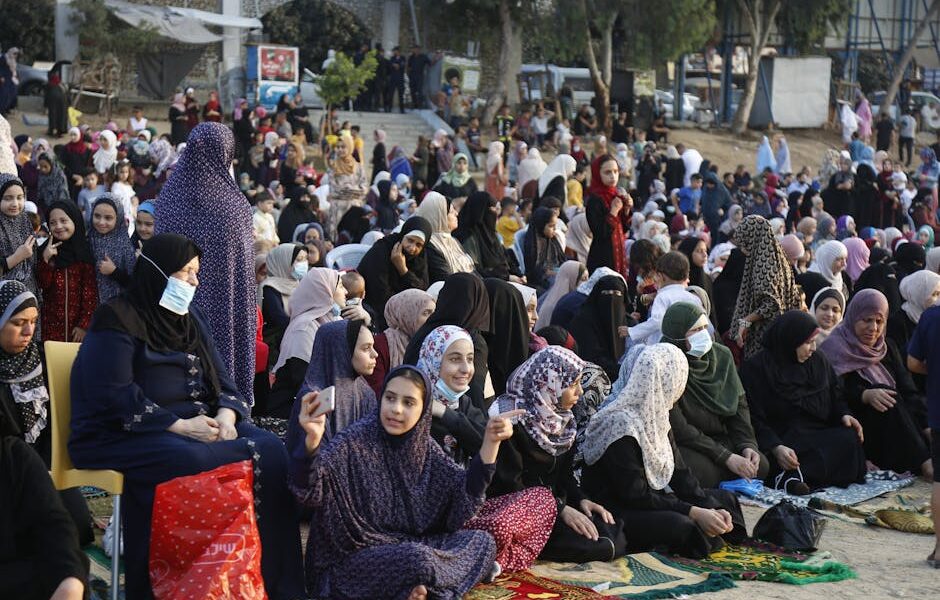
In the heart of Gaza, where the sky is often filled with drones instead of stars, the simple act of buying ice cream or walking through a lit street has taken on a meaning far beyond leisure. For many Palestinians, the Gaza Eid celebration in 2026 is not about abundance or tradition—it’s about endurance. It’s a quiet, collective statement that life, however battered, continues.
The recent holiday, meant to be a time of sacrifice and family gatherings, unfolded under the shadow of a devastating blockade and relentless airstrikes. For residents like Ohood Nassar, now displaced from her home in Jabalia and living in a rented house in Gaza City’s Remal neighborhood, this was the third Eid spent far from her family’s ancestral home. The joy of the holiday—the scent of grilled liver, the thrill of new clothes, the ritual sacrifice of a sheep—has become a luxury nearly impossible to afford.
The Price of Tradition in a Crumbling Economy: Gaza Eid Celebration Under Siege
One of the most powerful symbols of Eid al-Adha is the sacrifice of an animal, honoring the story of Prophet Ibrahim. But in Gaza, that tradition has been nearly extinguished by economics. Since October 2023, the Israeli blockade has banned the entry of livestock. The small number of surviving sheep now cost around $6,000 apiece—a tenfold increase from pre-war prices. For the average family, many of whom have lost homes and livelihoods, buying a sheep is out of the question.
The impact ripples outward. A kilogram of chocolate, a staple of Eid sweets, now sells for roughly $30. Nuts and biscuits, once shared with visiting relatives, are now prohibitively expensive. The festive atmosphere that once filled Gaza’s markets has been replaced by a somber reality: the holiday has become a mirror reflecting the war’s toll on daily life.
An Eid Night Turned Nightmare
On the night before Eid, amid a rare scene of bustling activity, Ohood stepped out with her mother and sister to buy ice cream from Kazem, a beloved local shop in Remal. The street was packed with families, children clutching new clothes, and vendors selling what goods they could. For a moment, it felt like pre-war Gaza.
Then the rockets hit.
What happened next, however, reveals something deeper about the human spirit. Within minutes, despite the chaos and fear, shoppers returned to the streets. Stalls stayed open until 4 a.m. People without money to buy anything still came, just to walk among the lights and reclaim a fragment of normalcy. “Truly, we are a people who love life,” Ohood wrote. This is not a cliché; it is a survival mechanism.
Resistance Through Ritual
The next morning, families placed sweets and nuts on tables that were half-empty. Ohood’s family ate frozen liver for breakfast—a memory of the fresh liver they used to eat after the Eid sacrifice. It was a small, deliberate act of holding onto the past. “We do not celebrate Eid because we are well,” Ohood reflected. “We celebrate because we are still alive. And we believe that our celebration itself is a form of resistance.”
This idea—that joy can be an act of defiance—is not unique to Gaza, but it is especially poignant here. Throughout history, oppressed communities have used festivals, music, and food to assert their humanity in the face of dehumanization. In Gaza, the Gaza Eid celebration becomes a daily proclamation: We are here. We will not vanish.
But this resistance comes at a brutal cost. As the funeral processions began in the afternoon on Eid day, chants of “There is no god but Allah, and the martyr is beloved to Allah” echoed through the streets. Among the 15 people buried that first day of Eid was commander Mohammed Awda, his wife, and three of their children—a family that had been preparing for the holiday only hours earlier. For many, the day shifted from celebration to mourning in an instant.
A Broader Context: The Weaponization of Hunger
While the focus is often on airstrikes and military targets, the blockade itself is a form of collective punishment that slowly strangles Gaza’s social fabric. By preventing livestock and essential goods from entering, the blockade doesn’t just cause hunger—it erodes culture. The inability to perform the Eid sacrifice or afford holiday sweets strips families of a key source of communal identity and spiritual comfort.
This is a subtle but devastating weapon. When a father cannot provide a lamb for his children, when a mother cannot buy chocolate for her daughter, the damage is not just economic. It is psychological. The joy of Eid, once a shared experience that bound generations together, becomes a painful reminder of what has been lost.
Finding Light in the Cracks
Yet, Gazans keep finding ways to push back. On the morning of Eid, despite everything, children wore their new clothes. Families visited each other. People gathered for prayers on damaged streets. The very act of celebrating in the face of destruction sends a message that the occupiers cannot control everything. They can bomb buildings, but they cannot bomb the desire to live fully.
Ohood’s story of returning to her window after the attacks—watching people shop, steal moments of laughter, and hold onto their joy—is a testament to this resilience. It is not naive optimism. It is a calculated, exhausting, and necessary choice. In a place where death is a constant companion, choosing life is the most radical act of all.
As Gaza enters another year of conflict, the question looms: How long can this spirit sustain itself? The shelling may stop and start, but the hunger and displacement are chronic. The real test of resistance may not be how many rockets are fired, but how many smiles can survive the rubble.
For more on the broader context, read about how the ceasefire dream fades in Gaza and Israel’s territorial grab and the fragile ceasefire. External sources: UNRWA and ICRC.