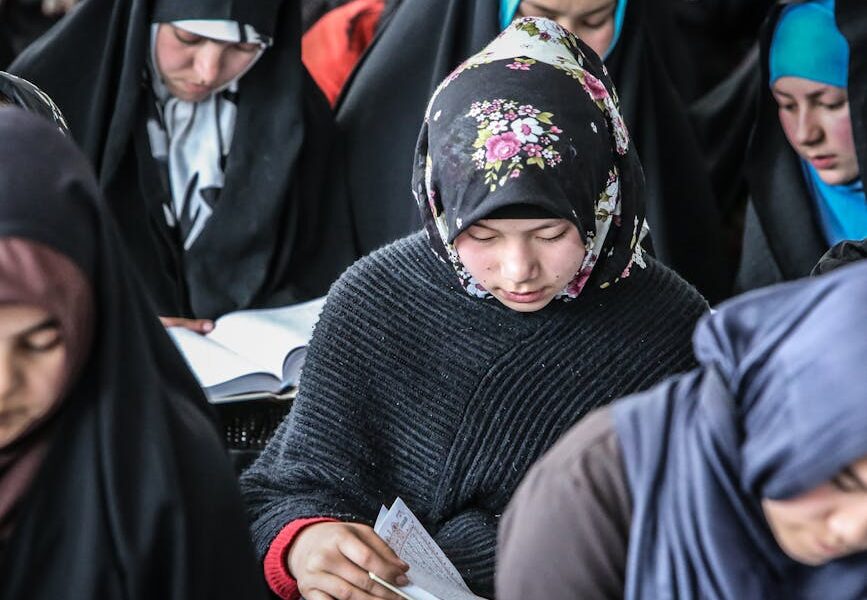
In a dusty, half-lit room on the outskirts of Kabul, a 19-year-old woman named Alia opens a notebook. Her fingers trace English words she’s learning—freedom, future, pilot. Each syllable is a small act of rebellion. Just months ago, she made a run for it: fled her village in Daykundi province by taxi, covered head to toe, her eyes the only visible part of her, gambling that Taliban checkpoints wouldn’t stop two women traveling alone. They didn’t. And now she’s here, enrolled in a private English course, buying time against an ultimatum she can’t outrun forever: marry or be married off. This is the grim reality of the Afghanistan education ban, which is forcing countless girls into early marriage.
Alia’s story is not just one of bravery—it’s a window into a brutal arithmetic that now governs millions of Afghan girls’ lives. Since the Taliban’s return in 2021, girls over 12 have been locked out of secondary school and university. Five years later, the path to a career, to independence, even to a simple adolescence, has been erased. What’s left, for most, is marriage. And not the kind they choose.
The Only Door Left Open: How the Afghanistan Education Ban Fuels Early Marriage
Before the ban, Alia’s parents pushed her to study. ‘They told me I could become a pilot,’ she says. Now the same parents, worn down by reality, tell her marriage is the best option. They still fund her English classes—an anomaly in a country where 75% of people can’t meet basic needs, per UN data—but even they can’t defy the system.
The Afghanistan education ban has created a vacuum. Private courses like Alia’s and madrasas (religious schools) are the only learning outlets for girls past primary. Neither is a substitute for formal schooling. And the cost? Out of reach for most. So for families like Shama’s, the decision becomes simple: when a girl reaches marriageable age, she must wed. Not because her mother wants it, but because the alternative—an unmarried woman in Taliban-run Afghanistan—draws suspicion, scrutiny, danger.
A Mother’s Impossible Choice
Shama, now 22, sits in a bare home in western Kabul, holding her infant daughter. A toddler plays at her feet. Four years ago, at 18, she was still dreaming of becoming a doctor. ‘If the Taliban hadn’t taken over, I would almost have finished school,’ she says. Instead, her mother Kamila—a widow who scrubbed floors to pay for her daughters’ education—pushed her into marriage.
‘I was terrified the Taliban would ask why she wasn’t married,’ Kamila explains. ‘I am illiterate. I wanted my girls to learn. But I had no choice.’ Shama turned down proposals before the takeover. ‘Education was more important to me than anything,’ she says. Now she watches movies and flinches when a female character studies or works. ‘I feel trapped in my home. I only live for my children.’
Her 18-year-old sister Nora sees the future closing in. ‘I’m too young to get married. I want to continue my education. It’s like being in prison,’ she says. ‘The Taliban said schools would reopen. We’ve been waiting for that message every day for four and a half years.’
The Official Silence
When pressed, Taliban spokesmen offer a shell game of excuses. In 2021, they said schools would open once security improved. In 2022, religious scholars had ‘concerns’ about girls’ safety traveling to school. In 2024, a deputy spokesman told me they were ‘awaiting a decision from the leadership.’ This month, when I asked again, he pointed to the millions of boys and girls studying in primary grades, then kicked the question to the education ministry—which never responded.
The strategy seems clear: stall, deflect, hope the world forgets. But the numbers don’t forget. The UN warns that if the ban persists until 2030, more than two million girls will have been denied secondary education in a country that already has one of the world’s lowest female literacy rates.
What the Numbers Miss
Statistics capture scale, not texture. They don’t show Alia huddled over an English textbook, or Shama’s silent tears, or Nora’s recurring dream of a classroom. They don’t capture the slow, grinding erosion of hope that happens when a society tells half its young women to give up on ambition and settle for a ring.
There’s a deeper cruelty here too, one the official figures miss entirely. The Taliban’s ban doesn’t just steal education—it steals choice. Marriage, for these girls, is no longer a partnership entered into freely; it’s a survival reflex. A way to avoid state scrutiny. A way for parents to protect daughters from a regime that sees unmarried women as deviant. The result is a generation of brides who never wanted to be brides, mothers who mourn the careers they’ll never have, and infants born into a system that already limits their futures.
Kamila, Shama’s mother, sums it up in words that could be an epitaph for millions: ‘I had so many dreams for her. But it didn’t happen.’
Resistance, One Taxi Ride at a Time
Alia knows she’s lucky. Her family has money; they’re funding her fight. But she also knows luck runs out. ‘If my family doesn’t force me to marry, I will resist until my last breath,’ she says. She took a taxi to that resistance. The question now is whether any number of taxis can outrun a system that’s closing every door but one.
For more on how the Afghanistan education ban affects girls, see our related article on Gaza’s Elderly Dream of Mecca While Trapped by Politics and War. Learn about the broader impact of crises on vulnerable populations in Syria’s Fractured Health System: A Hidden Emergency. For authoritative data, visit UNICEF and UN Women.