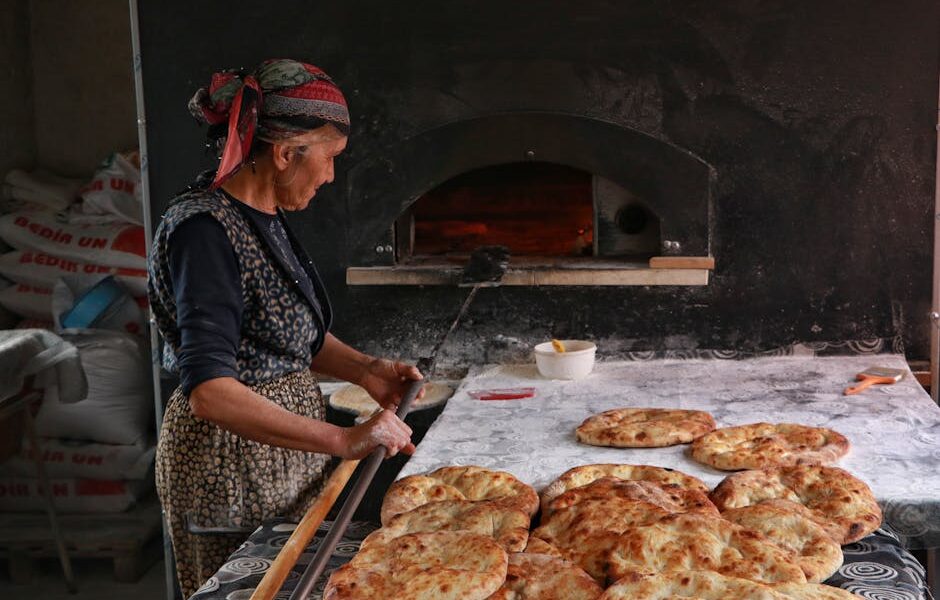
In times of war, bakeries often become the quiet heroes of survival. But when Soubhiye Zeiter lost her own home to the conflict, she didn’t retreat into grief. Instead, she rolled up her sleeves and started baking — not for herself, but for the hundreds of other displaced families around her. What began as a modest effort of 200 mana’eesh per day has since ballooned into a relentless operation producing 3,000 loaves daily. Her story is not just about bread; it’s about dignity, resilience, and the power of one person to rewrite the narrative of crisis.
Necessity Meets Invention
When Zeiter was forced to flee her residence, she could have easily become another statistic of displacement. Yet, she saw an opportunity where others saw despair. The first batch of 200 mana’eesh — a traditional Lebanese flatbread often topped with cheese, za’atar, or minced meat — was a trial run. Within days, word spread through the makeshift shelters and overcrowded schools housing the displaced. The demand was overwhelming, and Zeiter knew she had to scale up. Partnering with a few other displaced women, she secured a portable oven and began sourcing flour from local aid networks. Today, her makeshift bakery runs from dawn until late evening, producing bread that is distributed to families who have lost everything.
More Than Calories: The Social Lifeline of Bread
In Lebanese culture, bread is far more than a staple — it is a symbol of hospitality, community, and survival. “When you break bread with someone, you are saying, ‘You are not alone,’” explains Dr. Lina Haddad, a sociologist specializing in displacement at the American University of Beirut. Zeiter’s initiative taps into this deep cultural vein. Every loaf she bakes carries not just nutrition, but a message of solidarity. For families huddled in cramped quarters, receiving fresh mana’eesh can restore a sliver of normalcy, a reminder that life and tradition continue even amid destruction. This emotional dimension is often overlooked in humanitarian reporting, which tends to focus on logistics and statistics.
Expert Perspective: The Unseen Labor of Women in Conflict Zones
Zeiter’s story also highlights a broader pattern that experts say deserves more attention: women often become the primary first responders in prolonged crises, filling gaps left by formal aid agencies. “Men might be fighting on the frontlines or searching for work, but it’s women who rebuild the household economy from scratch — often through food production,” notes Rana Khoury, a field coordinator for a refugee support NGO based in Beirut. “Soubhiye is not an anomaly; she represents thousands of women across Lebanon, Syria, and Gaza doing the same quiet, invisible work. The difference is that her story reached a journalist.” This unpaid, underrecognized labor is what keeps communities alive during wars, yet it rarely makes it into policy discussions or funding priorities.
The Broader Context: Lebanon’s Deteriorating Safety Net
Zeiter’s operation exists against a backdrop of national collapse. Lebanon has been grappling with an economic depression since 2019, worsened by political paralysis and, now, renewed conflict. The official unemployment rate hovers above 30%, and the national currency has lost more than 95% of its value. Government services are virtually absent in many displacement zones, forcing citizens to rely on family networks, charities, and grassroots initiatives like Zeiter’s bakery. The fact that a single displaced woman can become the primary source of bread for an entire community is a testament to both her resourcefulness and the state’s failure. International relief organizations often struggle to reach deeply affected pockets due to security concerns and logistical hurdles, making local solutions not just helpful, but essential for survival.
What Keeps Her Going
Zeiter wakes at 4:00 AM each day, mixing dough in barrels that once held cooking oil. By 6:00 AM, the first batch is in the oven. She stops only when the flour runs out — which increasingly happens as supply chains are disrupted by fighting. Yet, she remains resolute. “I made a vow when I left my house,” she says. “As long as I have hands, I will make sure no one sleeps hungry here.” Her dedication has inspired others to contribute: a local merchant donates cheese, a teenager collects firewood, and children help package the warm loaves for distribution. This bottom-up economy of care stands in stark contrast to the top-down failures of political institutions.
A Call for Systemic Change
While Zeiter’s effort deserves admiration, it should not be romanticized. The fact that a civilian baker must become a lifeline points to a systemic breakdown that requires urgent policy response. Sustainable solutions must include ceasefire agreements, reconstruction of supply routes, and investment in local food production capacities. For now, however, Zeiter will keep baking. And for the families receiving her bread, each bite is a small act of defiance against a war that would rather see them starve.