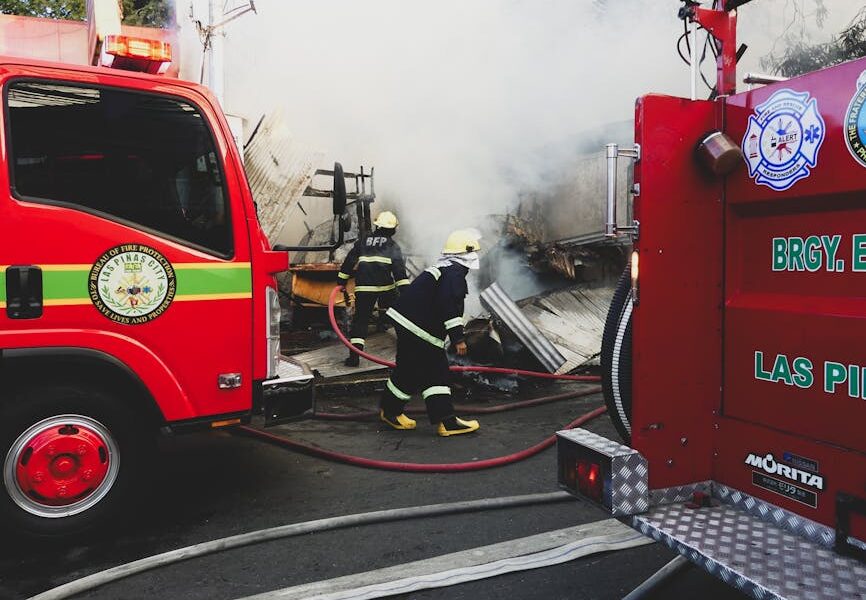
Just after dawn on a Saturday in late May, residents of one of Manila’s most crowded districts woke not to the hum of jeepneys, but to the roar of flames and the wail of sirens. A fire that officials now classify as a fifth-alarm blaze—the most severe designation in the Philippine capital’s response system—raged through a tight maze of wooden homes, leaving thousands scrambling for safety. By early afternoon, the fire had consumed entire blocks, sending a column of grey smoke visible for kilometres across the city.
The neighbourhood, a dense patchwork of improvised structures built on narrow lanes, is typical of many across Metro Manila. Here, homes are stacked on top of each other, electrical wires hang in tangles, and fire trucks simply cannot fit. When a fire starts—often from a cooking gas leak, faulty wiring, or an unattended candle—it spreads with terrifying speed. And this time, the wind was not on anyone’s side.
Why the Fifth Alarm Matters
Fire authorities in the Philippines use a five-alarm escalation system to determine the scale of a response. A first alarm sends a single fire truck. A fifth alarm means the bureau is pulling engines and personnel from multiple districts, calling in off-duty crews, and requesting support from nearby cities. This fire hit that level within hours, a sign that responders were quickly overwhelmed by the ferocity of the flames and the difficulty of access.
“We saw the smoke from three kilometres away—it was like a black wall moving sideways,” said a local merchant who lives two blocks from the evacuation zone. “The firemen couldn’t get their hoses through the alley; they had to connect them from the main road and drag them over rooftops.”
Beyond the Blaze: A Deeper Vulnerability
As dramatic as any large fire is, this event underscores a chronic issue in many fast-growing Asian cities: informal settlements built without firebreaks or adequate access for emergency vehicles. Manila’s building codes are strict on paper, but enforcement in older, poorer districts is patchy at best. The result is that a single accident can threaten hundreds of families in minutes.
What is striking is how quickly the community mobilised. While official responders fought the flames, neighbours formed human chains to pass buckets of water and helped elderly residents escape through second-storey windows. This is not new—Filipinos have long relied on bayanihan, the spirit of communal unity, in times of crisis—but it also reveals a gap: when the state’s resources cannot reach you, your neighbours are your first line of defence.
What Happens Now
In the coming days, the focus will shift from containing the fire to accounting for the displaced. Temporary shelters have been set up in a nearby school and a basketball court—a familiar sight in a country where typhoons often force similar evacuations. The local government has promised emergency cash assistance and the distribution of food packs, but for many families, the loss is total. Everything they owned—birth certificates, savings, photographs—turned to ash.
There is also the question of what will be rebuilt. Manila’s land is scarce and expensive, and residents of informal settlements often lack formal land titles. Without legal documentation, they cannot access government reconstruction loans, and the risk of being pushed to the city’s fringe is real. Advocates are already calling for the city to use this tragedy as a catalyst for safer, more equitable urban planning—not just another patch-up job.
As the smoke clears over Manila, the fire will fade from the headlines. But the deeper embers—of poverty, of inadequate infrastructure, of a city bursting at its seams—will continue to smoulder unless something more than a temporary evacuation is delivered.