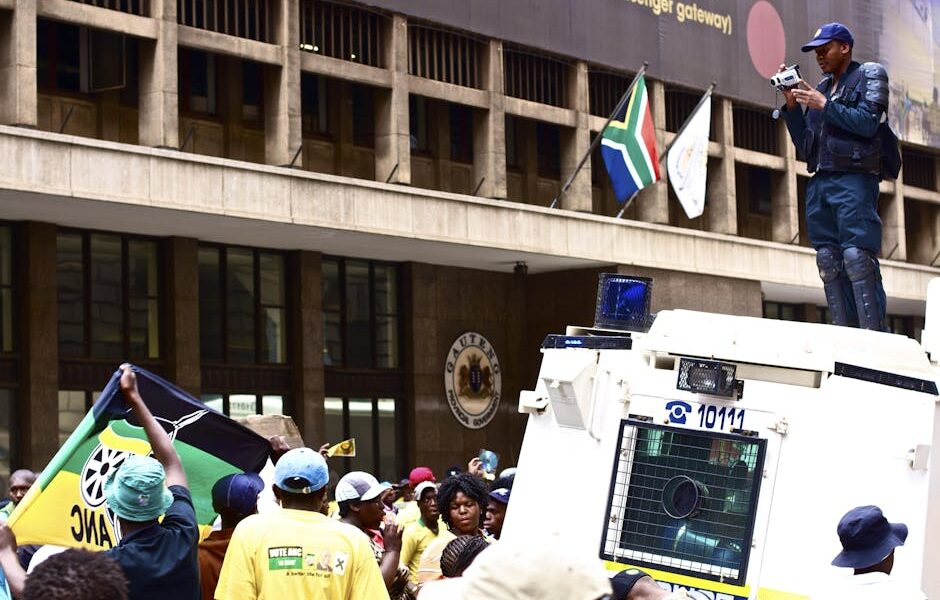
For decades, South Africa has been a beacon of hope for people across the African continent — a place where work is plentiful and the promise of a better life feels tangible. But lately, that beacon has flickered, casting long and uneasy shadows on the streets of Johannesburg, Pretoria, and Cape Town. Recent protests, marked by banners demanding foreign workers leave by the end of June, have once again thrust the nation’s fraught relationship with South Africa migration into the global spotlight.
This isn’t a new story. It’s a recurring chapter in a saga that has played out since the end of apartheid in 1994. But something feels different this time. The anger is sharper, the rhetoric more pointed, and the underlying questions more unsettling. Why is a country that once welcomed its neighbors now turning them away with such vehemence?
A History of Shifting Borders and Broken Promises in South Africa Migration
To understand the current tension, you have to look back. After apartheid fell, South Africa didn’t just open its doors — it practically threw them open. The new democratic government talked about African unity and regional integration. Migrants from Zimbabwe, Mozambique, Lesotho, and beyond poured in, often filling gaps in low-wage labor markets, from mining to domestic work. For a while, the system worked, if imperfectly.
But the honeymoon is long over. High unemployment — hovering around 32% — has turned every job into a potential battleground. Many South Africans feel their government has failed to enforce basic immigration laws, allowing what they see as a flood of illegal workers to undercut wages and strain public services. The sentiment is simple and painful: ‘Why are we taking care of foreigners when our own people are suffering?’
The Economic Myth and the Reality of Scapegoating in South Africa Migration
Economists will tell you a different story. Foreign workers don’t steal jobs; they often create them. Many start small businesses — hair salons, grocery stores, repair shops — that employ locals. Others take jobs South Africans don’t want, like the grueling work on commercial farms. The International Labour Organization has consistently found that migrants tend to complement, not compete with, native-born workers in most sectors.
But try telling that to a young man in Soweto who has been looking for work for three years. The nuance doesn’t matter when you’re hungry. Political figures have exploited that frustration, using migrants as a convenient scapegoat for the failures of the state. It’s easier to blame the ‘other’ than to fix a broken education system, a corrupt bureaucracy, or a stagnating economy.
What’s happening now is not merely about jobs. It’s about identity. As South Africa grapples with its own fractured sense of nationhood — still healing from the wounds of apartheid — the presence of millions of migrants from elsewhere on the continent forces a difficult question: What does it mean to be South African?
The Legal Jungle and the Human Cost of South Africa Migration
Immigration lawyer Ashraf Essop has seen it all. In his practice, he deals with cases of asylum seekers who have waited years for their paperwork, only to be told their application is lost. The system, he argues, is not just slow — it’s deliberately opaque. This lack of clarity creates a gray area where anyone with a foreign accent can be accused of being illegal.
‘It’s a vacuum,’ Essop says. ‘The government doesn’t manage borders effectively. It doesn’t process permits efficiently. So instead of fixing the system, we blame the people caught in it.’
The result is a cycle of fear and violence. Shops are looted. Homes are attacked. People are forced onto the streets, sometimes in the dead of night. The South African Human Rights Commission has documented dozens of such incidents over the past decade, yet prosecutions are rare. Impunity breeds resentment — on both sides.
A Regional Dilemma with No Easy Answers in South Africa Migration
Lindiwe Zulu, a former minister and member of the ANC, points out that South Africa cannot simply shut its borders. ‘We are part of the Southern African Development Community (SADC). We have treaties and obligations. We also have a moral duty,’ she said in a recent panel discussion. ‘But that duty must be matched by fairness for our own citizens.’
Fairness — that’s the word that keeps coming up. But fairness looks different depending on where you stand. For a Zimbabwean mother who fled political persecution, fairness means safety and a chance to earn a living. For a South African father who can’t find work, fairness means prioritizing his children over strangers.
Professor William Gumede of the University of the Witwatersrand offers a broader lens: ‘This is not just a South African problem. It’s a continental problem. Wealthier African nations attract migrants from poorer ones, and if those wealthier nations are unstable, the pressure increases. We need a pan-African solution to labor mobility.’
That solution remains elusive. The African Continental Free Trade Area aims to ease movement, but it’s a long-term fix. In the short term, the pressure cooker keeps building. The June 30 deadline looming over foreign workers is a symbol of that pressure — an artificial date that forces a confrontation rather than a conversation.
What Comes Next for South Africa Migration?
If history is any guide, the protests will die down, the deadline will pass — and the tension will simmer just below the surface until the next flare-up. But that’s not good enough. Without real reform — efficient permit processing, border management, job creation, and civic education — South Africa risks becoming a story of missed potential. A nation that once inspired the world now struggles to inspire itself.
The migrants aren’t going anywhere. And neither are the problems. The only question is whether the country can find a way to live with both — or whether it will keep tearing itself apart over who belongs and who doesn’t. For more on regional migration dynamics, see this related article on immigration divides. For authoritative data, consult the International Organization for Migration.