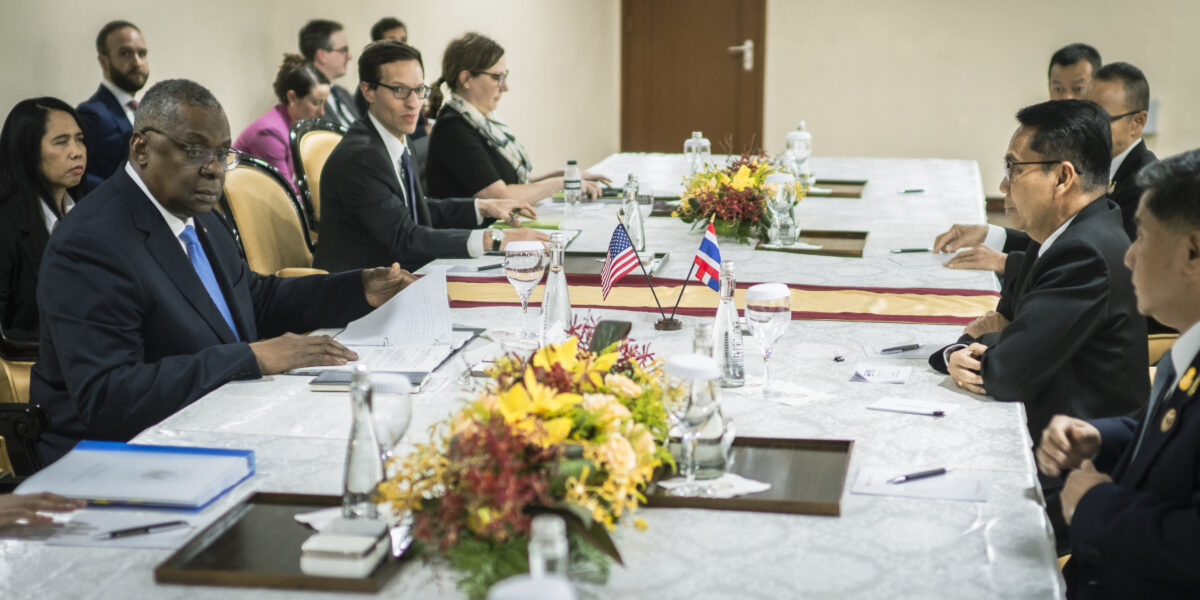
Speaking to a packed auditorium in Singapore, US Defense Secretary Pete Hegseth delivered a blunt message to Asia-Pacific allies: Washington remains committed to the region, but the era of American security on a discount is over. The Asia allies defense spending must now step up and spend far more on their own defense, or risk being left vulnerable in an increasingly dangerous neighborhood.
Hegseth’s appearance at the Shangri-La Dialogue came at a moment of deep uncertainty. Just weeks after President Donald Trump held friendly talks with China’s Xi Jinping in Beijing, regional partners are quietly asking whether the United States is turning its gaze — and its firepower — elsewhere, particularly toward the ongoing war in Iran. The defense secretary tried to extinguish that doubt, but the fine print of his message was anything but reassuring.
Asia Allies Defense Spending: Two Fronts, One Superpower
“People want to conflate that we have global obligations with the turning of our backs to this region,” Hegseth said, denying any shift in priorities. He insisted the US can manage simultaneous crises: supporting allies in Asia while preventing Iran from obtaining a nuclear weapon. But as one Pentagon official put it behind closed doors, “We’re not Superman. We’re just very well-equipped.”
Japan’s defense minister Shinjiro Koizumi had pressed the issue directly, warning that some nations may try to “drive a wedge” between the US and its partners. Hegseth’s reply was a mix of reassurance and demand: America’s “power projection” in the Pacific remains a top priority, but the bill for that protection is going up.
The 3.5% Target: A New Floor for Asia Allies Defense Spending
Perhaps the most pointed moment came when Hegseth urged Asian allies to set a new defense spending target of 3.5% of GDP — a higher bar than even NATO’s current 2% guideline. He praised South Korea, Japan, Australia, and the Philippines for recent increases in military expenditure and cooperation with US forces. But he also took aim at “freeloaders,” explicitly naming New Zealand as a country that needs to contribute more.
- Current US defense spending: approximately 3.4% of GDP
- NATO guideline: 2% of GDP
- Hegseth’s new target for Asia: 3.5% of GDP
“Rules are great, but if you can’t back them up with hard power, the rules are not worth the paper they are written on,” Hegseth declared. “We don’t need more conferences, we need more combat power… less Shangri-La Dialogue, more ships and more subs.”
Taiwan: A Delicate Silence
Notably, Hegseth avoided any direct mention of Taiwan in his prepared speech — a sharp contrast to his 2024 address, where he called China’s buildup an “imminent threat” to the island. This year, he adopted a softer tone, saying the US seeks a “stable equilibrium” in which “no state including China can impose its hegemony.” The shift comes after Trump’s apparently warm meeting with Xi in Beijing, where the Chinese leader warned that Taiwan is the “biggest issue” between the two powers.
When pressed on a suspended $14 billion weapons package to Taiwan — reportedly halted to conserve munitions for the Iran conflict — Hegseth insisted the two issues were separate. “We are in a very good place… very strong position” regarding overall munitions stockpiles, he said, while declining to give a timeline for resuming the transfers.
Original Insight: The Unspoken Transactional Shift
What the original reporting didn’t explore is the deeper transformation underway. This is not merely a budgetary ask — it is a fundamental redefinition of what it means to be a US ally. Historically, Washington provided security as a public good, underpinning decades of Asian economic growth. Hegseth’s speech marks a pivot toward a transactional alliance model: you get what you pay for. This could accelerate a fragmentation of regional security, where smaller nations must choose between a demanding US, an encroaching China, and their own limited budgets. The quiet fear in the room was not about America leaving — but about America staying, and charging admission.
China’s Absence Speaks Volumes
For the second consecutive year, China declined to send its defense minister to the Shangri-La Dialogue, opting instead for a lower-level delegation. Some analysts interpret this as a deliberate snub; others see Beijing avoiding a direct public confrontation with the US on a global stage. Whatever the reason, the empty chair underscored the growing gulf between the two powers — even as Hegseth preached “measured and deliberate strength” rather than confrontation.
Vietnam’s President To Lam, in his own keynote, offered a counterpoint: more dialogue, not less. But in a hall where hard power was the currency of the day, his call for talk felt like a whisper against the drumbeat of rearmament.
What Comes Next for Asia Allies Defense Spending
The bottom line for Asia allies defense spending is clear: the American security blanket now comes with a price tag. Countries like Japan and Australia, already increasing defense budgets, may find themselves aligning with the new target. Others, like New Zealand, face pressure to reshape their defense posture. Meanwhile, the US continues to juggle commitments from the Pacific to the Middle East, asking a fundamental question of its partners — how much is your protection worth?
As one Southeast Asian defense official said after Hegseth’s address: “We want the US to stay. But we also need to know what staying will cost us — in money, in policy, and in our relationships with everyone else.”
For more on regional security dynamics, see our analysis of Fiji’s port deal reshaping Pacific dynamics. Also, learn about Trump’s Iran deal dilemma affecting US commitments. For authoritative perspectives, visit the IISS Shangri-La Dialogue official site and U.S. Department of Defense.