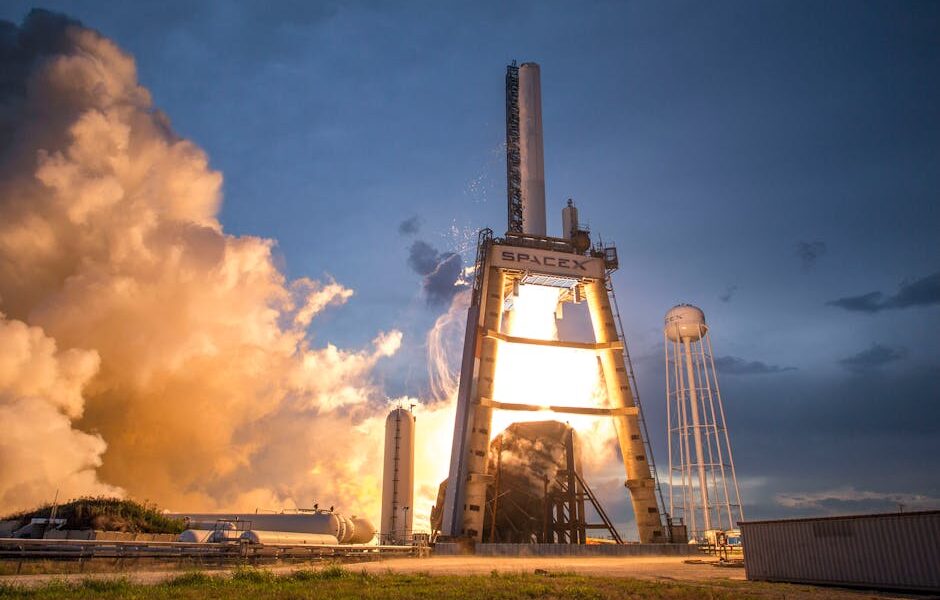
When a rocket explodes, it usually means something went horribly wrong. But when SpaceX’s Starship V3 erupted over the Indian Ocean last Friday, the company was cheering. That fireball wasn’t a failure — it was the final planned step in a test designed to push the limits of the most powerful launch vehicle ever built.
For the average person watching from home, the sight of a giant spacecraft disintegrating in the sky might feel like a spectacle of disaster. In reality, it’s part of a deliberate strategy that has become central to how SpaceX develops its technology: fly often, break things, learn fast.
A Flight That Almost Went Perfectly
Lifting off from Texas after a one-day delay — caused by a sticky hydraulic pin in the launch tower — the Starship V3 climbed higher and faster than any previous version. It completed most of its major mission objectives, including stage separation and a controlled descent toward the Indian Ocean. But not everything went according to plan. Both the Super Heavy booster and the upper stage experienced engine failures during the flight.
SpaceX engineers had already programmed the vehicle to self-destruct on splashdown. Because the rocket wasn’t designed to survive a landing on water, they chose to destroy it rather than leave a massive piece of debris drifting in the ocean. The explosion was intentional — a controlled termination that protected the test zone and provided valuable data on how the vehicle behaves under extreme stress.
The Philosophy of Rapid, Messy Testing
This is where SpaceX departs dramatically from traditional aerospace. NASA and legacy contractors spend years simulating and verifying every possible failure mode on the ground before risking a launch. Elon Musk’s company prefers to test in the real world, accepting that many test flights will end in fire. The approach has produced remarkable results — Falcon 9 is now the most reliable rocket in operation — but it also means public failures are part of the process.
Some industry experts argue that this method wastes resources and creates unnecessary risk. Others point out that it has already accelerated development timelines by years, forcing innovation at a pace that simulations alone can’t match. For SpaceX, each explosion is a data point, not a catastrophe.
What’s at Stake Beyond the Fireball
Starship V3 is not just another rocket. It’s the vehicle that SpaceX intends to use for crewed missions to the Moon under NASA’s Artemis program, and eventually for the first human flights to Mars. The stakes couldn’t be higher. A rocket that can’t consistently survive reentry or landing won’t carry astronauts. But a rocket that never flies will never improve.
The Indian Ocean test also underscores a deeper challenge: even with the most advanced engineering in the world, spaceflight remains brutally difficult. Engines fail. Guidance systems glitch. And sometimes the only way to know if a design works is to light the candle and see what happens.
For the millions of people who dream of seeing humans walk on another planet, Friday’s explosion wasn’t a setback. It was just another step on a very long, very fiery road.