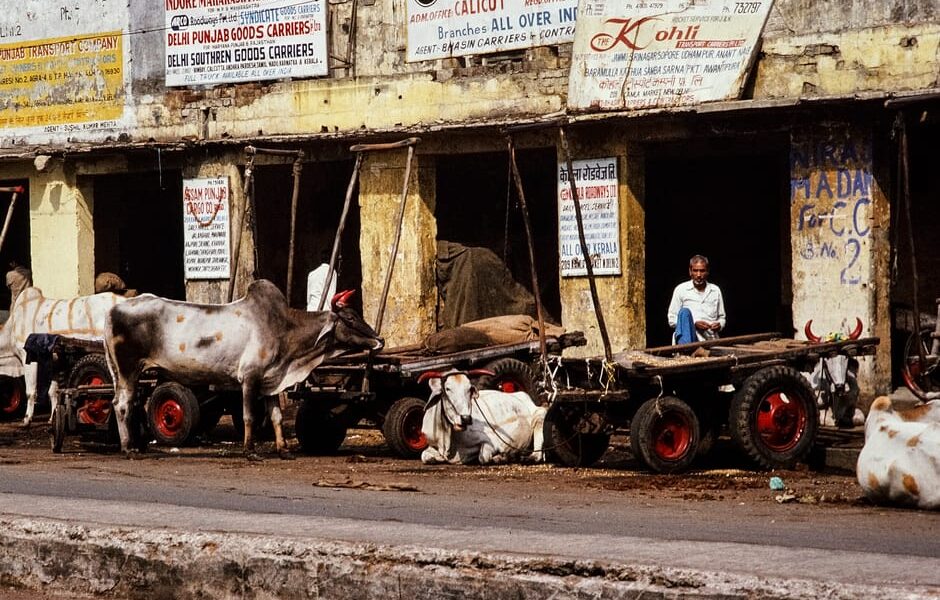
KOLKATA — In the sweltering heat of late May, the Dhulagarh cattle market on the outskirts of Kolkata should be buzzing with haggling voices and the lowing of livestock. Instead, rows of buffalo and goats stand tethered to bamboo poles. The only sounds are the sighs of traders fanning themselves under a tin shed. With Eid Al-Adha West Bengal just days away, the market is nearly empty.
This isn’t just a slow sales season. It is a glimpse into how a seismic political change is altering daily life in one of India’s most culturally complex states.
West Bengal has long been a place where a relaxed attitude toward cattle trading and beef consumption coexisted with a predominantly Hindu population. For decades, Marxist and centrist governments declined to enforce a 1950 law that bans the slaughter of cattle without a government certificate. The result was a unique food culture, with beef kebabs and meat curries sold from street carts and in restaurants across Kolkata, a city known for its culinary diversity.
But since May 6, when Narendra Modi’s Hindu-majoritarian Bharatiya Janata Party (BJP) won control of the state for the first time, a climate of uncertainty has swept through the cattle trade. New Chief Minister Suvendu Adhikari ordered the strict implementation of the old law, which requires that all animals be declared “fit for slaughter” by a government official and butchered only in licensed municipal abattoirs. The law also sets a minimum age of 14 years for cattle to be slaughtered—a condition that critics say is designed to make lawful killing nearly impossible.
Eid Al-Adha West Bengal: From Boom to Bust in a Week
The effect on the ground has been immediate. Traders who relied on holiday sales to recoup loans—sometimes taken at high interest against family jewelry—now face ruin. Sundor, a Muslim cattle trader who goes by a single name, borrowed one million rupees (about $10,500) against his mother’s gold ornaments to buy 25 cows for Eid. Last year he sold nearly 100. This time? Not one.
“We usually make around 10 to 15 lakh rupees during the festive season,” he says, standing next to unsold animals. “What will I do now? I am really scared.”
His Hindu counterparts are also feeling the pinch. One construction laborer from East Midnapur district, who switched to cattle trading for the holiday, says he has sold only a few animals and faces losses of around 5,000 rupees (about $53) for every unsold cow. “Who will buy a cow? People are living in fear,” he says, asking not to be named.
Beef Disappears from the Menu
The crackdown hasn’t stopped at the markets. Across Kolkata, a city famous for its beef burgers and spiced meat rolls, restaurants and vendors are quietly dropping beef from their menus. The Burger Shop, a popular local chain, posted on Instagram that it had paused its beef burgers after its supplier was called to a police station and told to temporarily close. “Our burgers have no religion. But politics sure does,” the post read.
Meat shops in New Market, a historic shopping district, now close by 1:30 p.m. instead of the usual 7 p.m. Mohammad Hasim, a 65-year-old shop owner whose family has run licensed meat stalls for three generations, says suppliers are too scared to deliver, and eateries are too afraid to buy. “In the decades we have stayed in Kolkata, we have always seen peace. Now things have turned topsy-turvy,” he says.
More Than Just Meat
The fear extends beyond the cattle trade. In Muslim-majority neighborhoods like Park Circus and Mullick Bazaar, shopkeepers report that the pre-Eid rush has vanished. “The markets are empty. It has never been like this,” says a lungi seller who refuses to give his name. Some residents say newly elected BJP legislators have told them not to offer namaz—daily prayers—on the streets, a common practice when mosques overflow during Friday and Eid prayers.
This shift, many observers say, is not just about law enforcement. It is about identity. For the BJP and its ideological parent, the Rashtriya Swayamsevak Sangh (RSS), cow protection is a signature issue that mobilizes Hindu voters. Since Modi became prime minister in 2014, vigilante groups have lynched dozens of Muslims and Hindu traders on suspicion of cow slaughter or beef consumption. Now, that campaign has found official expression in West Bengal.
An Expert View: The Law as a Political Tool
Jayasimha Nuggehalli, a lawyer and former member of India’s Animal Welfare Board, says these laws are rarely about animal welfare. “Their design and implementation are more closely linked to questions of identity, trade, and rural livelihoods,” he explains. “What we are seeing in West Bengal is part of a broader trend in which cattle and meat regulation has become a site of political contestation.”
An Economic Toll That Will Outlast the Holiday
The long-term damage may extend far beyond this Eid. For small-scale farmers and traders, the loss of income from the festival—a once-a-year windfall—can mean defaulting on loans, selling land, or migrating to cities for work. The ripple effect hits transporters, feed suppliers, and the restaurants that depend on cheap meat.
Activist and writer Harsh Mander suggests the BJP’s victory signals a deeper ideological mission. “For the past 100 years, the RSS has worked to reshape Indian society along majoritarian lines,” he says. “West Bengal is now the laboratory for that project.”
Back at Dhulagarh, the sun beats down on the unsold livestock. A few traders pray that a last-minute buyer will appear before the holiday begins. Most have already accepted their losses. One of them sums it up quietly: “This year, there is no joy in the market. Only fear.”
For more on how political shifts affect communities, read about the human cost of India’s exam crisis. The situation in West Bengal also echoes broader trends in global tensions stress-testing systems. For further reading, see BBC’s coverage of India’s cattle laws and Al Jazeera’s analysis of the BJP’s win.