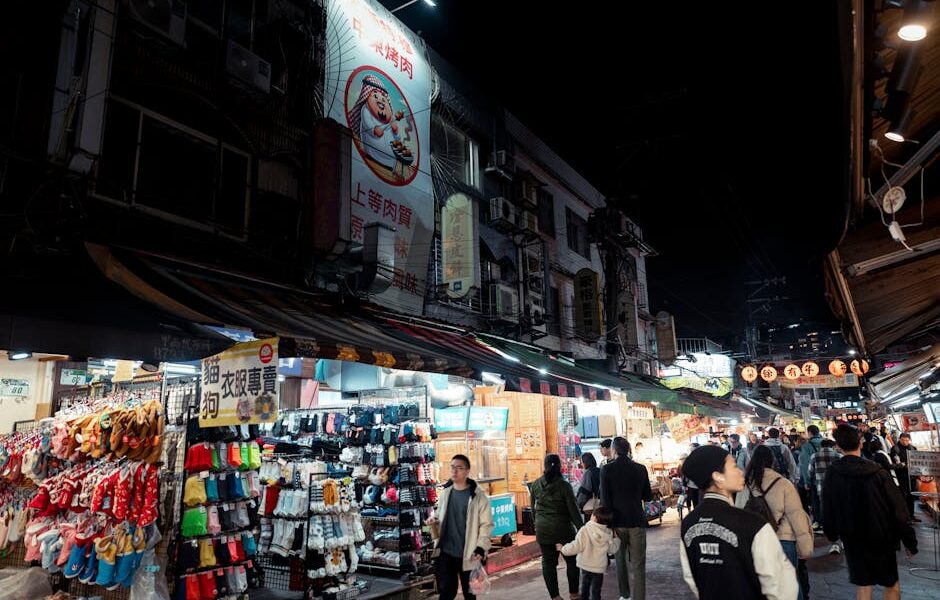
Walking through the neon-lit lanes of Taipei’s Shilin Night Market, you’d never guess that this island is the global engine room of the artificial intelligence revolution. Stalls sell stinky tofu and bubble tea, vendors haggle over prices, and the biggest digital worry for most shopkeepers is whether the credit card machine works. Yet just a few miles away, in sterile clean rooms in Hsinchu, engineers are fabricating the world’s most advanced chips—the brains powering ChatGPT, self-driving cars, and the next generation of supercomputers. This stark contrast highlights a growing Taiwan AI economy inequality that is reshaping the island’s social fabric.
Taiwan’s economy is on a historic tear. Gross domestic product expanded by a blistering 8.63 percent in 2025, followed by a 13.69 percent surge in the first quarter of 2026. Exports hit $640.7 billion last year, with tech goods making up more than two-thirds of that. The Taiwan Semiconductor Manufacturing Company (TSMC) alone now accounts for over 40 percent of the island’s entire stock market value. On paper, these numbers are the stuff of economic fairy tales.
But beneath the headline figures, a quieter story is unfolding—one of widening inequality, rising anxiety, and a sense that the AI party has a very exclusive guest list.
The K-Shaped Recovery: Taiwan AI Economy Inequality in Focus
Central Bank Governor Yang Chin-lung recently warned that Taiwan is developing what economists call a K-shaped economy. In this model, the top branch of the K—high-tech sectors like semiconductors and AI—shoots upward, while the bottom branch—retail, hospitality, traditional manufacturing—stagnates or declines. This isn’t just an abstract concept. Data shows that while the semiconductor industry employs only about 300,000 people out of a workforce of 11 million, the broader electronics and IT sector employs around one million. Compare that to the roughly seven million workers in the service sector, many of whom are seeing wages barely keep pace with inflation.
Ryan, a tech engineer who asked to use only his first name, put it bluntly: “I feel that the benefits of economic growth haven’t been distributed evenly. Some industries or asset holders benefit significantly, but ordinary office workers often experience a rise in prices and housing costs, rather than an easier life.”
His sentiment echoes across the island. Real average wages grew just 1.4 percent in 2025, and median wages rose 1.35 percent. But the Directorate-General of Budget, Accounting and Statistics reports that 70 percent of Taiwanese earn less than the average—a stark reminder that a handful of six-figure tech salaries are distorting the national picture. In the semiconductor sector, pay is nearly double the national average.
From Living Room Factories to Corporate Giants
To understand what’s being lost, you have to look back at Taiwan’s post-war economic miracle. Historian James Lin, who studies Taiwan’s economic transformation, describes the “living room factory” model of the 1970s to 1990s. Back then, hundreds of thousands of small and medium-sized family enterprises produced everything from bicycle parts to plastic molds. Growth was broad-based, and wealth trickled down to communities, not just shareholders.
“The benefits of that period were widely distributed across Taiwanese society,” Lin says. “Today, wealth inequality is growing as land becomes more expensive and large corporations like TSMC attract the lion’s share of foreign capital investment.”
The shift is structural. In the 1980s, Taiwan’s Gini coefficient—a measure of inequality where zero equals perfect equality—stood at 0.308, on par with Norway. By 2024, it had crept up to 0.341. While that still compares favorably to many developed economies, the trajectory is troubling for a society that once prided itself on shared prosperity.
The Stock Market Band-Aid
One consolation for ordinary Taiwanese has been a red-hot stock market. The Taiwan Stock Exchange more than doubled in value between 2019 and 2025, hitting $2.2 trillion. Regulatory changes in 2020 made it easier for small investors to buy single stocks, sparking a retail trading frenzy. By January, there were 13.77 million trading accounts—equivalent to 60 percent of Taiwan’s population.
The exchange itself has hailed this as a “cornerstone for inclusive prosperity.” But critics argue that stock market wealth is illusory for many. It rewards those who already have capital to invest, and it’s volatile. A market correction could wipe out gains for retirees and first-time investors who jumped in during the euphoria.
Wei-ting Yen, an assistant research fellow at Academia Sinica, notes that the reliance on stock market gains to offset wage stagnation is fragile. “If the AI bubble deflates or if geopolitical tensions escalate, those paper gains vanish overnight,” she warns.
The Global Headwinds You Can’t Ignore
It would be easy to blame domestic policy for the growing divide, but some challenges are external. Former central bank official Chao-Hsi Huang points to US tariffs under President Donald Trump, which have partially exempted semiconductors but hit traditional exporters hard. Because Taiwan cannot sign free trade agreements due to its contested diplomatic status, its non-tech manufacturers face higher tariffs than competitors in South Korea, Japan, or Southeast Asia.
“We are treated differently, and that’s a difficulty we’re facing,” Huang says.
Meanwhile, the central bank has kept the New Taiwan Dollar relatively weak to maintain export competitiveness. That helps companies like TSMC, but it erodes the purchasing power of ordinary consumers, who pay more for imported goods from food to fuel.
An Original View: The Hidden Cost of Specialization
What strikes me most about Taiwan’s current predicament is a paradox that few are addressing directly: the very success of its AI sector is creating a form of economic monoculture. Like a farmer who plants only one crop, Taiwan is reaping bumper harvests now, but the soil is being depleted. Human capital—smart graduates, ambitious entrepreneurs, skilled labor—is being sucked into a single industry. Young people who might have started a restaurant, opened a design studio, or built a solar energy firm are instead flocking to semiconductor engineering programs, lured by salaries that are double or triple what they could earn elsewhere.
This brain drain from other sectors stifles innovation in the broader economy. It also leaves Taiwan dangerously exposed. If the AI boom slows—due to market saturation, a geopolitical crisis, or a technological shift that favors a different architecture—the island could find itself with a highly specialized workforce and a hollowed-out middle class. The “living room factories” of the past were resilient because they were diverse; a clothing maker could pivot to electronics. Today, a chip fabs cannot pivot to running a bakery.
Taiwan’s government has announced initiatives to promote green energy and biotech as second pillars, but the investment and talent flows still overwhelmingly favor semiconductors. Until that changes, the K-shaped economy will likely widen, and the neon lights of Taipei’s night markets might keep shining—but they’ll be lighting a society that is increasingly split between those who ride the AI wave and those who watch it pass by.
For more on how economic disparities affect societies, see our analysis of global tensions stress-testing systems. Additionally, learn about how heatwaves are rewriting extreme weather rulebooks.
For further reading on AI and inequality, visit World Economic Forum’s insights on AI and inequality and OECD’s AI policy observatory.