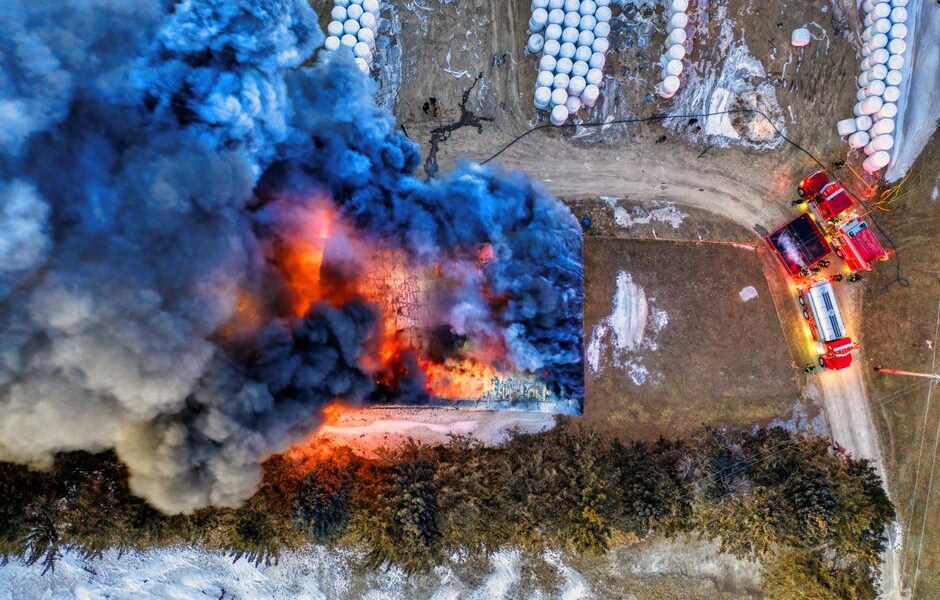
When debris from a Russian drone crashed onto a residential apartment building in the Romanian city of Galati early Friday morning, it didn’t just shatter windows and set a fire. It sent a chill through the entire NATO alliance, marking a dangerous NATO drone incursion on allied soil.
Two people suffered minor injuries, and emergency alerts sent residents scrambling into the night as Romanian F-16s and a helicopter scrambled to respond. But beyond the immediate scene, the incident marks a troubling pattern: the war in Ukraine is no longer staying inside Ukraine’s borders. For the third time in as many months, a Russian drone has breached the airspace of a NATO member state, and this time it hit a home.
“We cannot accept that Russia’s war of aggression is physically transferred to our citizens,” Romania’s President Nicusor Dan said in a statement, his words carefully measured but unmistakably firm. He ordered the foreign ministry to present a series of diplomatic measures “proportionate to this very serious situation.”
‘Ineptitude or Intent’—Does It Matter in a NATO Drone Incursion?
Polish Foreign Minister Radoslaw Sikorski summed up the dilemma bluntly: “Regardless of whether it was on purpose or the result of ineptitude, Russia is still dangerous and we must defend ourselves against it.” That sentiment is increasingly shared across the alliance. But it also exposes a deeper anxiety. If the alliance treats every incursion as a deliberate provocation, it risks escalation. If it dismisses them as accidents, it risks emboldening Moscow.
European Commission President Ursula von der Leyen called the strike a sign that “Russia’s war of aggression has crossed yet another line.” But the line between accident and aggression has been blurring for months. Estonia, Lithuania, Latvia, and Finland have all reported drone or missile incursions. Latvia’s government even collapsed earlier this month over how to handle the repeated violations.
What makes the Galati crash different is that it caused physical harm and property damage inside a NATO country. That pushes the conversation from abstract warnings to concrete consequences—and forces allies to decide just how much tolerance they have for Russian “mistakes.”
Romania Pushes for Faster Anti-Drone Defenses
Outgoing Romanian Prime Minister Ilie Bolojan announced that Bucharest would sign a contract within hours to acquire anti-drone systems under the EU’s SAFE program. But the country’s foreign ministry also called on NATO to accelerate the transfer of anti-drone capabilities across the eastern flank. The message is clear: current defenses aren’t enough to stop drones that fly low, fast, and under the radar.
France’s Minister for European Affairs Benjamin Haddad reminded the public that French troops are already stationed in Romania as part of NATO’s forward presence. “This incident highlights the threat Russia poses to European security,” he said. But some analysts point out that stationing troops doesn’t solve the drone problem—you can’t shoot down a Shahed with a soldier on the ground.
A Fragile Article 5
Underneath all the diplomatic condemnations and emergency alerts lies a question that no one in Brussels wants to ask out loud: Would NATO actually invoke Article 5 if a Russian drone killed someone in Bucharest or Warsaw?
President Donald Trump has openly hinted that the United States might not honor the collective defense clause in certain scenarios. While NATO Secretary General Mark Rutte rushed to reassure the public that “Russia’s reckless behaviour is a danger to us all” and that the alliance “will defend all of its territory,” his words felt more like a plea than a promise.
United Nations Secretary-General Antonio Guterres warned that the escalation could spiral “out of control,” noting that more civilians have been killed in the first four months of this year than in the same period in the previous three years. He called for “a full and unconditional ceasefire” and immediate de-escalation. But with no diplomatic off-ramp in sight, the burden falls on NATO to define what counts as an attack—and how far it’s willing to go to stop one.
What the Kremlin Wants
Russia’s foreign intelligence service recently warned the Baltic states that their NATO membership would not protect them from retaliation if they allowed Ukraine to launch strikes from their territory. That threat is not empty. Moscow knows that every drone incursion, whether accidental or deliberate, chips away at the public’s trust in NATO’s ability to protect them.
And the numbers back up the concern. Ukrainian forces reported shooting down 217 of 232 drones launched overnight Friday, with one ballistic missile striking targets across 14 regions. The sheer scale of Russia’s nightly assaults means that some drones will inevitably leak through—and geography makes Romania, Poland, and the Baltic states the most vulnerable catch basins.
Russian officials have repeatedly listed facilities in Europe that they claim are involved in manufacturing drones for Ukraine. Intelligence analysts warn that Moscow is increasingly treating the entire continent as a legitimate battlefield—not with ground troops, but with cheap, hard-to-detect drones that can cross borders faster than diplomats can hold emergency meetings.
The New Normal?
For residents of Galati, Friday was a terrifying wake-up call. But for many analysts, it was the predictable outcome of a war that has long since stopped respecting international borders. The question now isn’t whether another drone will crash on NATO soil—it’s what the alliance will do when one of those drones causes more than minor injuries.
Romania has summoned Russia’s ambassador, and Foreign Minister Oana Toiu promised to communicate “the consequences that this lack of responsibility will have for diplomatic relations.” But in a conflict where diplomacy has failed for years, and where sanctions have not changed Moscow’s calculus, the real test will be whether NATO can upgrade its defenses fast enough to keep the war from moving permanently into its own backyard.
The drumbeats of a wider conflict are getting louder. Whether they lead to war—or to a more serious push for peace—depends on what happens the next time a drone crosses that invisible line.
For more on how similar incidents have tested alliances, read about a drone strike on Romanian soil raises the stakes in NATO’s balancing act. Also, see Strait of Hormuz tensions flare again as US and Iran test fragile ceasefire for another geopolitical flashpoint.
Learn more about drone warfare from authoritative sources: CSIS analysis on drone warfare in Ukraine and Reuters coverage of Russian drone strikes in Romania.