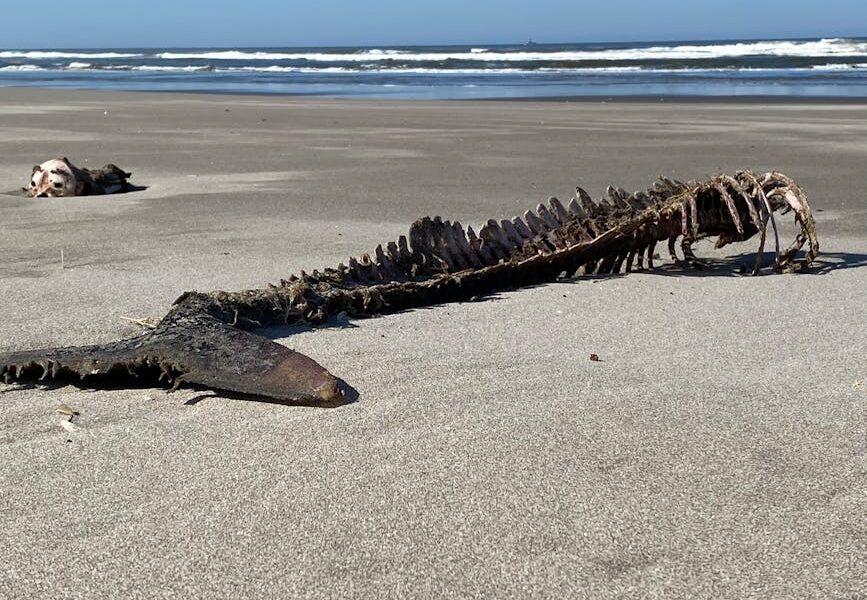
What began as a heart-wrenching rescue mission on Germany’s Baltic coast has turned into a logistical, olfactory, and somewhat macabre spectacle on a tiny Danish island. Two weeks after a private operation to save a stranded humpback whale ended in tragedy, the enormous carcass—now bloated with gas and threatening to explode—has become an unexpected tourist attraction and a major headache for environmental authorities.
The Unexpected Aftermath of a Failed Rescue
The whale, which had been nicknamed “Timmy” by German media after the Timmendorfer sandbank where it first got stuck, was eventually ferried out to sea by a barge at the end of April. But instead of swimming free to the North Sea, the animal’s body reappeared over the weekend on the shores of Anholt, a remote island in the Kattegat strait about 57 kilometers from mainland Denmark.
The Danish Environmental Protection Agency quickly identified the carcass using a GPS tracker that had been attached during the rescue attempt. Now, the agency faces a race against time—and rising gas pressure—to remove the rotting mammal before it bursts or causes a public health hazard.
A Gas-Filled Ticking Time Bomb
Islanders were initially warned to keep a safe distance due to infection risks. But as one local woman explained, the whale had become impossible to ignore: “It’s around 20 to 30 meters from the beach, but it’s drifting along the shore.” The decomposing body has visibly expanded as internal gases build up, raising fears of an explosion that could scatter flesh and bacteria across the sand.
“That’s nature. I know some people are worried, but I’m not,” the same resident told reporters, displaying the stoic pragmatism often found in island communities.
On Thursday, an emergency response team attempted to tow the carcass into deeper water before transferring it to a larger vessel bound for the port of Grenaa. But the operation hit a snag almost immediately. According to Jane Hansen from the environmental agency, “After several attempts, the whale has now become stranded on a sandbank some distance from the shore. The operation has therefore been temporarily paused while the emergency response team explores alternative options.”
From Tragic Rescue to Tourist Magnet
The story has taken an almost surreal turn as German tourists, who followed the whale’s saga for months, have started arriving on Anholt just to see the carcass. Some of these visitors had previously referred to the animal as “Hope,” reflecting the emotional investment in its survival. For the islanders, this sudden interest is bewildering.
But the situation also underscores a broader truth: in the age of social media and 24-hour news cycles, even a dead whale can become a symbol. The failed rescue, which involved two private entrepreneurs, drew criticism from marine experts who had warned from the start that the humpback was too weak to survive. “It was very weak and at risk of drowning,” German authorities had said as early as April, advising against false hope.
What Really Happened to Timmy?
Exactly how the whale ended up stranded on a German beach in the first place remains unclear, though entanglement in fishing netting is suspected. After a first rescue attempt in Lübeck Bay, the whale swam east along the coast, eventually reaching the island of Poel. There, it was loaded onto a barge and released about 70 kilometers from the northern tip of Denmark. Then it vanished—until its bloated body emerged off Anholt.
The Danish agency still intends to tow the carcass to Grenaa for a post-mortem examination and scientific sampling. But the next attempt is unlikely before the end of Denmark’s long public holiday weekend, leaving residents and visitors to watch, wait, and hold their noses.
A Reflection on Our Relationship with Nature
Beyond the logistical challenges and the dark humor, this story offers a quiet lesson about the limits of human intervention. We do our best to save stranded animals, driven by compassion and a sense of responsibility. But the ocean is vast and indifferent. The whale named Hope did not survive, yet its body continues to teach us—about decomposition, about currents, and about the strange ways we mourn in the modern world.
For now, the bloated humpback sits on a sandbank, slowly deflating its mystery into the Baltic air, while the small community of Anholt waits for the final act of a drama that refuses to end.